


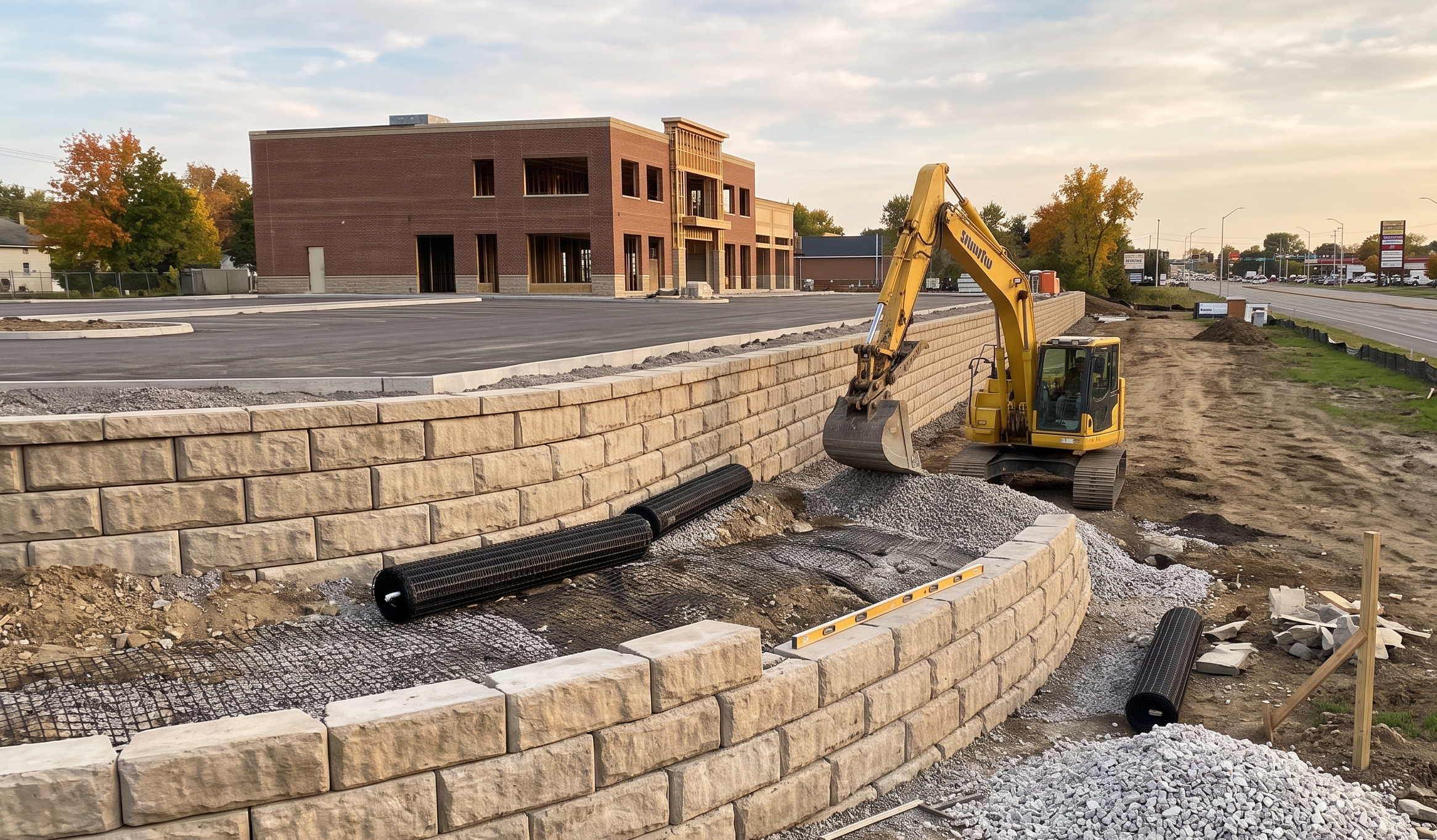
Managing a commercial property in Western New York comes with its own unique set of structural and environmental challenges. When property managers, civil engineers, and business owners evaluate commercial retaining walls for Buffalo, they look for solutions that balance site stability, code compliance, and long-term durability. From multi-level shopping centers along Niagara Falls Boulevard to industrial distribution hubs in Cheektowaga, engineered earth-retention systems play a critical role in maximizing buildable space, stopping soil erosion, and protecting valuable hardscape infrastructure.
At 10xlandscaping, we design and install heavy-duty retaining structures engineered specifically to withstand Western New York’s intense freeze-thaw cycles, high moisture loads, and clay-heavy soil conditions.
Frequently Asked Questions
Q: Why are commercial retaining walls essential for Buffalo property developments?
A: They allow developers to create level, usable surfaces for parking lots and buildings on sloped terrain while stabilizing soil along high-traffic commercial corridors.
Q: How does Buffalo’s clay soil impact retaining wall installation?
A: Clay holds significant moisture and expands when frozen. Proper excavation and aggregate replacement are critical to keep expanding soil from pushing against the wall face.
Why Buffalo Commercial Properties Need Engineered Retaining Structures
Commercial properties in the Queen City operate in a demanding climate. Between lake-effect snowstorms, rapid spring thaws, and dense clay subsoils, site retainment demands far more than basic landscaping blocks.
When installed correctly, commercial retaining systems deliver several vital operational benefits:
- Maximizing Usable Footprint: Convert unusable slopes into flat, buildable ground for additional parking stalls, loading docks, or outdoor dining space.
- Controlling Stormwater & Hydrostatic Pressure: Western New York winters mean water trapped behind a structure can freeze, expand, and push forward. Proper drainage channels reduce water accumulation and prevent structural wall failure.
- Preventing Slope Failure: Protect building foundations, access roads, and municipal rights-of-way from soil movement and erosion during severe weather events.
- Enhancing Commercial Value: A well-designed modular or poured concrete wall adds clean architectural lines and crisp curb appeal to office parks, retail plazas, and industrial facilities.
Frequently Asked Questions
Q: Can a retaining wall help expand an existing commercial parking lot?
A: Yes, installing an engineered retaining wall at a slope’s edge allows you to cut into an elevation or fill behind the wall, creating flat square footage for extra parking spaces.
Q: How do retaining walls manage heavy snowmelt in Western New York?
A: Integrated drainage systems divert bulk groundwater runoff away from the property’s main foundations and into municipal stormwater management systems.
Technical Considerations for Western New York Climate
The structural longevity of any commercial wall in the Buffalo area comes down to engineering for local soil composition and climate extremes.
Fighting Hydrostatic Pressure and Deep Frost Lines
In the Buffalo region, the frost line typically extends 42 to 48 inches into the ground. When water-saturated clay soil freezes, it exerts lateral forces that easily displace unengineered walls.
- Deep Footing & Levelling Pads: Excavation must account for frost depth to ensure the base layer rests on stable, well-compacted aggregate.
- Backfill Aggregate & Geotextiles: Utilizing clear angular stone (such as #57 crushed limestone) behind the units ensures rapid water evacuation through perforated drainage pipes rather than allowing water to pool behind the wall face.
- Geogrid Reinforcement: For taller structures (typically over 4 feet), synthetic geogrid mesh extends deep into the backfill zone, turning the soil mass into a unified structural block.
Frequently Asked Questions
Q: What depth must commercial retaining wall footings reach in Buffalo?
A: Base footings must be placed beneath the local frost line (generally 42 to 48 inches deep) or engineered with a compacted aggregate base layer that prevents frost heave from lifting the structure.
Q: What is geogrid, and why is it necessary for taller commercial walls?
A: Geogrid is a high-tensile, flexible mesh layered into backfill soil. It binds the soil mass together to resist lateral pressure on walls exceeding 4 feet in height.
Popular Commercial Retaining Wall Systems
Depending on project scope, load requirements, and site aesthetics, different structural systems suit different commercial applications:
| Wall Type | Ideal Application | Key Advantages | Structural Considerations |
| Segmental Concrete Blocks (SRW) | Retail centers, office complexes, parking lots | Versatile finishes, built-in pin connection systems, easy integration with geogrid | Requires proper backfill compaction and geogrid anchoring above 4 ft |
| Cast-in-Place Concrete | Heavy industrial, high-load loading docks, structural abutments | High lateral load strength, seamless finish options | Higher initial labor cost; requires precise rebar placement and concrete curing |
| Large-Block Modular Systems | Deep cut-and-fill projects, heavy highway/transit corridors | Fast installation using heavy equipment, massive deadweight resistance | Requires crane or heavy excavator machinery access |
| Anchored/SoIl Nail Walls | Tight property lines, steep slopes where excavation is restricted | Minimal footprint required behind the wall face | Specialized engineering is required. |
Frequently Asked Questions
Q: Which commercial wall system is best for heavy vehicle loading docks?
A: Cast-in-place concrete or large-block modular systems offer the highest deadweight resistance and lateral strength required to withstand heavy semi-truck forces.
Q: How long do segmental concrete block walls typically last?
A: Manufactured with high-density precast concrete and built with clear gravel backfill, segmental walls carry a service life of 50 to 75+ years.
Regulatory Compliance, Permits, and Engineering Standards
In Erie and Niagara Counties, municipal building departments enforce strict codes on earth-retention structures:
- Engineering Requirements: Walls exceeding 4 feet in exposed height generally require wet-stamped engineering drawings from a licensed New York State Professional Engineer (PE).
- Permitting: Sites must secure local building permits and soil disturbance approvals and ensure alignment with local stormwater management regulations (SWPPP) prior to groundbreaking.
- Property Lines & Easements: Commercial installations must account for utility lines, set-backs, and neighboring parcel boundaries to ensure long-term site compliance.
Frequently Asked Questions
Q: When is a licensed Professional Engineer (PE) required in New York?
A: New York State building code typically mandates stamped structural drawings from a licensed PE for any wall over 4 feet tall or structures supporting tiered slopes and heavy vehicle surcharges (such as parking lots or loading bays).
Q: What site permits are needed before commercial excavation in Erie County?
A: Projects generally require local municipal building permits, standard utility stakeouts (811 Dig Safe), and Stormwater Pollution Prevention Plan (SWPPP) approval if disturbing large ground areas.
Finding Commercial Retaining Wall Installation Near Me (Service Coverage Area)
If you are searching for a reliable commercial retaining wall contractor near me in Western New York, proximity and fast site response matter. We provide full-service civil grading, excavation, and structural retaining wall installations across the following local municipalities:
- Erie County: Buffalo, Cheektowaga, Amherst, West Seneca, Orchard Park, Clarence, Hamburg, Lancaster, and Tonawandas.
- Niagara County: Niagara Falls, North Tonawanda, Lockport.
Whether your site sits along the I-90 corridor or near the Buffalo Niagara International Airport, local crew dispatch ensures timely inspections, equipment staging, and project delivery.
Frequently Asked Questions
Q: How quickly can an emergency or structural site inspection be scheduled in Erie County?
A: Local dispatch teams can typically conduct an initial on-site evaluation within 24 to 48 hours across the Buffalo-Niagara metro region.
Q: Do you service commercial sites outside city limits?
A: Yes, we cover the entirety of Erie and Niagara Counties, providing earthwork and structural retainment for suburban business parks and industrial corridors.
Visit Our Office & Local Service Map
Elevate Your Commercial Property Infrastructure
Whether you are expanding an existing facility, stabilizing a steep slope, or developing a new commercial site in Western New York, partnering with an experienced site contractor ensures your investment stands firm for decades.
Contact the team at 10xlandscaping today to schedule an on-site consultation, review structural requirements, and obtain a detailed estimate for your commercial project.
Frequently Asked Questions
Q: How do I request a site evaluation for a commercial retaining wall?
A: Reach out to 10xlandscaping.com/ to schedule an initial site visit where engineers measure grade elevations, inspect soil conditions, and outline structural requirements.
Q: Can 10x landscaping handle both site excavation and engineered wall construction?
A: Yes, we provide end-to-end commercial earth-moving, site grading, wall construction, and stormwater integration under one contract.