


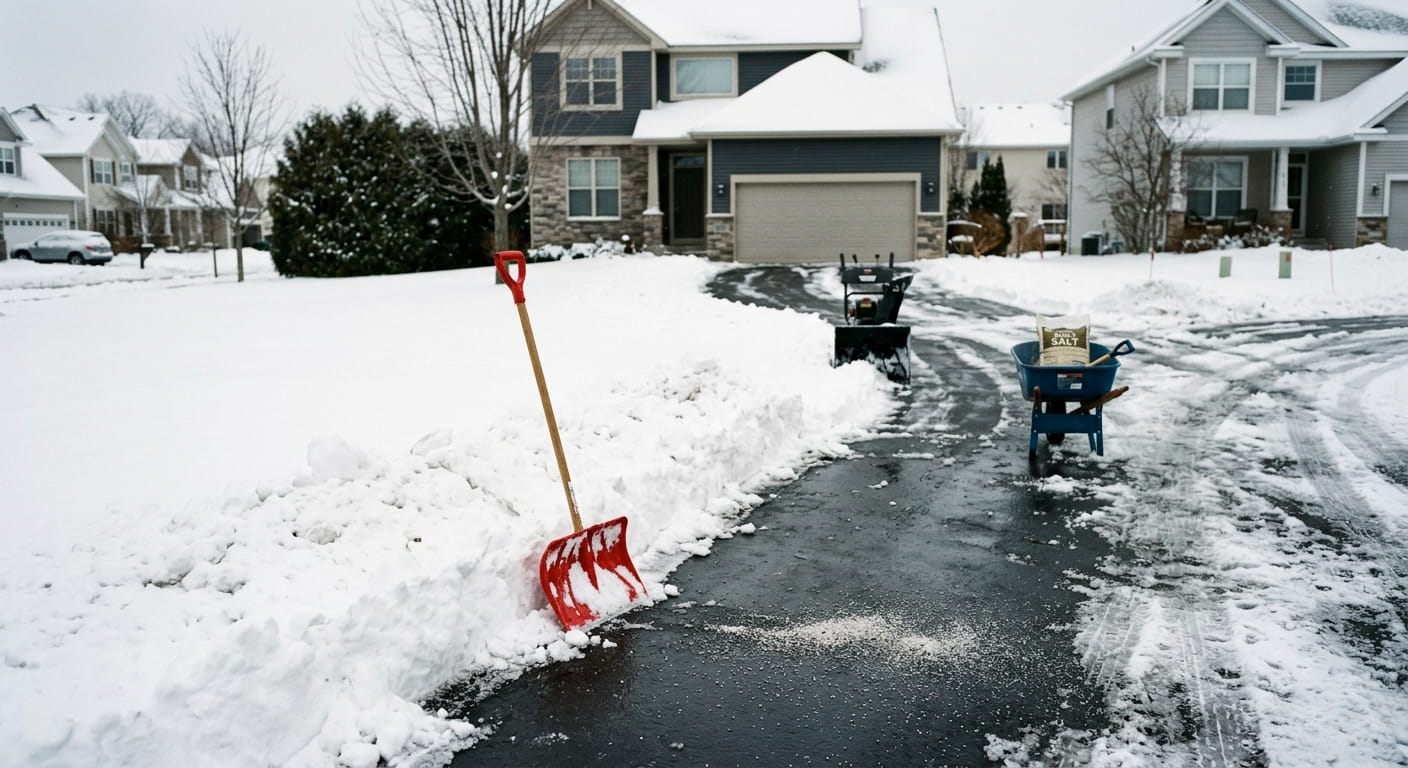
If you’ve lived in Western New York for more than one winter, you already know the routine. The forecast says “2 to 4 inches,” the lake decides it means 14, and by 6 a.m. there’s a wall of heavy snow between your garage and the street, with a crusty plow ridge sitting right where your driveway meets the road.
We’re the team at 10x Landscaping & Snow Plowing Service, and for more than five years we’ve been clearing driveways, lots and private roads around Buffalo, Orchard Park and the rest of Erie County. We also talk to plenty of homeowners who clear their own driveways and want to do it faster and safer.
This guide is what we’d tell a neighbor over the fence: which methods actually work on our kind of snow, the order to clear things in, how to stay safe, how to de-ice without damaging your driveway, and the mistakes we see every single winter.
Before the First Storm: 10 Minutes of Prep That Saves Hours
Most driveway headaches in January start with things nobody did in November. A little prep goes a long way:
- Stake the edges. Put reflective driveway markers along both sides, especially near lawn edges, garden beds and the curb. Once there’s a foot of snow down, nobody can tell where the asphalt ends, and blades and augers chew up turf fast.
- Plan where the snow goes. Pick your pile spots now. Keep them away from the downhill side (meltwater refreezes into an ice rink), away from your mailbox and hydrant, and off the sight lines you need when backing out.
- Service the blower before you need it. Fresh fuel with stabilizer, a spark plug check, spare shear pins in your pocket. The first big lake-effect event is the worst time to discover it won’t start.
- Watch the forecast source that matters. For lake-effect timing and band placement, the National Weather Service Buffalo office is far more useful than a generic weather app.
The Best Way to Clear Driveway Snow: Methods Compared
There is no single “best” method. The right tool depends on how much snow fell, how wet it is, how long your driveway is and, honestly, how much you enjoy being outside at dawn. Here’s how the common snow removal methods stack up for a typical Buffalo-area driveway.
1. Shoveling (the right way)
A shovel is still the right tool for light snow, short driveways, steps and walkways. The trick is to use the right kind. A wide push shovel (sometimes called a snow pusher) lets you slide snow to the side instead of lifting it, which is easier on your back and much faster on flat pavement. Keep a smaller, lighter scoop shovel for steps and for throwing snow onto the pile.
Shoveling works best when the snow is under about 4 inches and on the dry side. Once you’re into heavy, wet lake-effect snow, a full shovel can weigh a surprising amount, and that’s when injuries happen.
2. Single-stage vs. two-stage snow blowers
A single-stage blower scrapes the pavement and throws snow in one motion. It’s great for paved driveways with light to moderate snow, but it struggles with deep, wet snow and can’t handle the dense plow ridge at the end of the driveway.
A two-stage blower uses an auger to gather snow and a separate impeller to throw it. It chews through heavy snow and that frozen street-end windrow, and with its adjustable skid shoes raised, it can clear a gravel driveway without launching stones through your garage window. If you own a long driveway in Orchard Park, Hamburg or the Southtowns, a two-stage machine is the tool that earns its keep.
3. Clearing snow without a shovel
Plenty of people ask us about clearing snow without a shovel. There are a few legitimate options, each with limits:
- Leaf blower: surprisingly effective for an inch or two of dry, powdery snow on walks and steps. Useless on wet snow.
- Hiring a plow service: the most realistic “no shovel” option for most homeowners.
4. Professional plowing
A plow truck clears a full driveway in minutes, handles storm totals no homeowner wants to touch, and deals with the street ridge for you. The trade-off is cost and timing, since you’re on a route. Our snow plowing service page explains how routes and triggers work, and our snow removal cost guide breaks down what homeowners in the Buffalo area typically pay.
Snow removal methods compared
| Method | Best for | Handles heavy wet snow? | Physical effort |
|---|---|---|---|
| Push / scoop shovel | Under 4″, walks, steps, short driveways | Poorly | High |
| Single-stage blower | Paved driveways, light–moderate snow | Somewhat | Moderate |
| Two-stage blower | Long or gravel driveways, deep snow, plow ridge | Yes | Moderate |
| Leaf blower / mats / tarp | Light, dry snow on small areas | No | Low |
| Professional plowing | Any storm, any driveway length | Yes | None |
What is the best way to clear driveway snow in Buffalo?
For most homes, a two-stage snow blower plus a push shovel for edges and steps. For long driveways or households that leave early, a seasonal plow contract is usually the smarter call.
Can I use a single-stage blower on gravel?
We don’t recommend it. Single-stage augers touch the ground and will pick up and throw stones. Use a two-stage blower with the skid shoes raised, and leave a thin base layer of snow over the gravel.
Tired of fighting the plow ridge every morning?
10x Landscaping & Snow Plowing Service offers residential driveway plowing across Buffalo, Orchard Park and surrounding Erie County towns, on a seasonal contract or per visit.
How to Remove Snow From a Driveway: The Right Order of Work
This is where most homeowners lose time. Clearing in the wrong order means moving the same snow twice, or burying the part you just finished. Here’s the order our crews follow, adapted for a homeowner with a shovel or blower:
- Go early and go in stages. During a long storm, clear every 3–4 inches instead of waiting for it to stop. Light snow is easier to move, and you avoid packed layers that turn to ice underneath.
- Open a path to the door first. Clear the front steps and walkway so you (and the mail carrier) have safe access, and so you’re not tracking snow back into the house.
- Cut a center strip down the driveway. Run your blower or push shovel straight down the middle, throwing or pushing snow toward one side. Then work outward in overlapping passes.
- Throw with the wind, not into it. Check the wind direction before you start. Blowing snow back onto cleared pavement (or into your own face) is the classic rookie move.
- Don’t forget the essentials. Clear snow away from your furnace and dryer vents, gas meter and fire hydrant. Blocked vents can push carbon monoxide back into the home.
- Leave the street-end apron for last. The city or town plow will leave a dense windrow across the end of your driveway. If you clear the apron first, you’ll just be doing it again an hour later.
- Finish with de-icer or traction. Once the surface is clear, treat slopes, steps and walkways. More on that below.
A local tip on the plow ridge: before the town plow comes through, clear a “catch pocket” in the snowbank on the side of your driveway the plow approaches from (the upstream side, before your driveway). The plow dumps some of its load there instead of across your apron.
Should I wait until the snow stops to clear my driveway?
Not in a long storm. Clearing in stages keeps the snow light enough to move and stops a hard, icy base from forming. For short events of a few inches, waiting until it stops is fine.
Where should I pile driveway snow?
On your own property, downhill from nothing important, away from sight lines and out of the street. Plowing, shoveling or blowing snow into the road is illegal in New York under Vehicle and Traffic Law §1219.
How to Shovel Snow Safely
Sore backs, falls on hidden ice and heart strain are the three big snow-season injuries, and the heart risk is the one people underestimate. The American Heart Association warns that heavy shoveling in cold air raises heart rate and blood pressure sharply, and its 2020 scientific statement lists snow shoveling among activities that can trigger cardiac events, especially in people who don’t exercise regularly. A few habits make a big difference:
- Push, don’t lift, whenever you can. When you must lift, bend your knees, keep the load small and your back straight.
- Never twist to throw. Turn your whole body and step toward the pile.
- Pace yourself. Take a break every 15–20 minutes, stay hydrated and skip a heavy meal or alcohol right before or after shoveling.
- Know your limits. If you have a heart condition or other health concerns, talk to your doctor before shoveling, or hand the job to someone else.
Snow blower safety
According to the U.S. Consumer Product Safety Commission, more than 4,700 snow blower injuries were treated in U.S. emergency rooms in 2022, and over a third involved the wrist, hand or fingers. The pattern is almost always the same: someone reaches into a clogged chute. Always shut the engine off and use a cleanout tool or stick, never your hand, even if the auger seems stopped. And never run a gas blower in a closed garage; the exhaust carries carbon monoxide.
Is it bad to shovel heavy wet snow?
It’s the most strenuous kind. Take smaller loads, push instead of lift, and clear in stages so you never face the full depth at once.
What’s the safest way to clear a clogged snow blower?
Turn the engine off, disengage the controls, wait for all moving parts to stop, then use the plastic clearing tool that came with the machine or a sturdy stick.
De-Icing Without Damaging Your Driveway
De-icer should be your finishing step, not your plan. Put it down after the snow is cleared, and use only as much as you need. The right product depends on how cold it is:
- Rock salt (sodium chloride): cheap and widely available, but it slows down dramatically once temperatures fall into the teens, which is common in a Buffalo January.
- Calcium chloride: works at much lower temperatures and acts quickly. A good choice for steps and slopes in a deep freeze.
- Magnesium chloride: works in deep cold and is often marketed as the gentler option, but lab research from Washington State and Montana State universities found it can weaken concrete over repeated freeze-thaw cycles, so don’t treat it as “concrete-safe.”
- Sand or grit: doesn’t melt anything, but adds traction when it’s simply too cold for de-icer to work.
Protect your surfaces. Avoid heavy salting on concrete that’s less than a year old, and never use products containing ammonium nitrate or ammonium sulfate on concrete. Sweep up excess once the ice is gone. Overused salt also washes into lawns, storm drains and local waterways. The NYS Department of Environmental Conservation’s “Don’t Be Salty, New York” campaign asks homeowners to shovel first and salt sparingly; DEC notes that a single teaspoon of salt can pollute five gallons of water. If you have pets, look for pet-friendly products and wipe their paws after walks.
Want your driveway cleared and treated before you leave for work?
Our crews at 10x Landscaping & Snow Plowing Service handle driveway plowing plus salting and de-icing for homes and businesses across Buffalo and Orchard Park.
Driveway Snow Removal Mistakes to Avoid
These are the mistakes we see every winter, often on the same streets:
- Waiting for the whole storm to end. Two feet of settled, wet snow is a lot harder than three passes of eight inches.
- Driving on the snow before clearing it. Tire tracks pack the snow into ice ruts that last until March.
- Salting before shoveling. You end up with slush that refreezes overnight. Clear first, then treat.
- Piling snow at the bottom of a slope or next to the garage door. Meltwater runs back across the driveway and freezes.
- Burying the fire hydrant or blocking vents. Both are genuine safety issues.
- Pushing snow into the street. Besides creating a hazard for drivers and plows, it’s illegal statewide under NY Vehicle and Traffic Law §1219, with fines of up to $150 for a first offense.
- Scraping pavers or stamped concrete with metal edges. Use a poly-edge shovel or raise the blower skid shoes slightly.
- Ignoring the forecast. Lake-effect bands can dump several inches an hour in one neighborhood and leave the next one dry. Keep an eye on 511NY and local alerts before heading out.
What Makes Buffalo Driveways Different
Driveway snow removal tips written for other regions don’t always hold up here. A few things are unique to Buffalo and Erie County:
- Lake-effect snow comes fast and in bands. Totals can vary wildly across a few miles, so Orchard Park, West Seneca and the Southtowns can get buried while North Buffalo sees flurries. Staged clearing matters more here than almost anywhere.
- The snow is often heavy. Early and late-season storms bring wet, dense snow that breaks cheap shovels and stalls single-stage blowers.
- Freeze-thaw cycles are brutal on pavement. Melt during the afternoon, refreeze at night. Proper drainage and smart pile placement prevent ice sheets and protect your asphalt.
- Sidewalk deadlines in the city. City of Buffalo property owners are responsible for clearing the sidewalk in front of their home, by 9 a.m. the day after snow falls, or risk an order to remedy or a fine.
- Parking bans and plow schedules. Cars on the street during a snow emergency slow down municipal plowing and can make your apron ridge worse. Follow your town’s announcements.
When DIY Stops Making Sense
Clearing your own driveway is completely doable, and plenty of our neighbors enjoy it. But it’s worth considering professional help when:
- Your driveway is long, sloped or gravel, and a single storm takes you more than an hour.
- You leave for work before the town plows finish, and you’re regularly digging out in the dark.
- You travel during winter, or you’re caring for an elderly parent’s home as well as your own.
- Health, injury or age makes heavy shoveling a real risk.
If you’re weighing it up, these guides will help: seasonal snow contract vs. per-visit plowing, how often a driveway should be plowed, when to book snow removal, and questions to ask a snow removal contractor before you sign.
Driveway Snow Removal FAQs
What is the fastest way to remove snow from a driveway?
A two-stage snow blower working in straight, overlapping passes with the wind at your back. For deep snow, professional plowing is fastest by far.
How do you remove snow from a driveway without a shovel?
For light snow, a leaf blower works on dry powder. Heated driveway systems are an option when a driveway is being replaced. For real Buffalo storms, hiring a plow service is the practical option.
How do I get ice off my driveway after the snow is cleared?
Apply calcium chloride or magnesium chloride in cold weather, give it time to work, then scrape up the loosened ice. Add sand for traction if it’s too cold for de-icer.
Does 10x Landscaping clear driveways in Orchard Park?
Yes. 10x Landscaping & Snow Plowing Service plows and clears residential driveways in Buffalo, Orchard Park and surrounding Erie County communities. Contact us to check your street.
Let the Buffalo snow pros handle it this winter.
Whether you want every storm handled on a seasonal contract or just need help after the big ones, 10x Landscaping & Snow Plowing Service keeps driveways, parking lots and private roads clear across Buffalo, Orchard Park and Erie County. A local crew with 5+ years of lake-effect experience.