


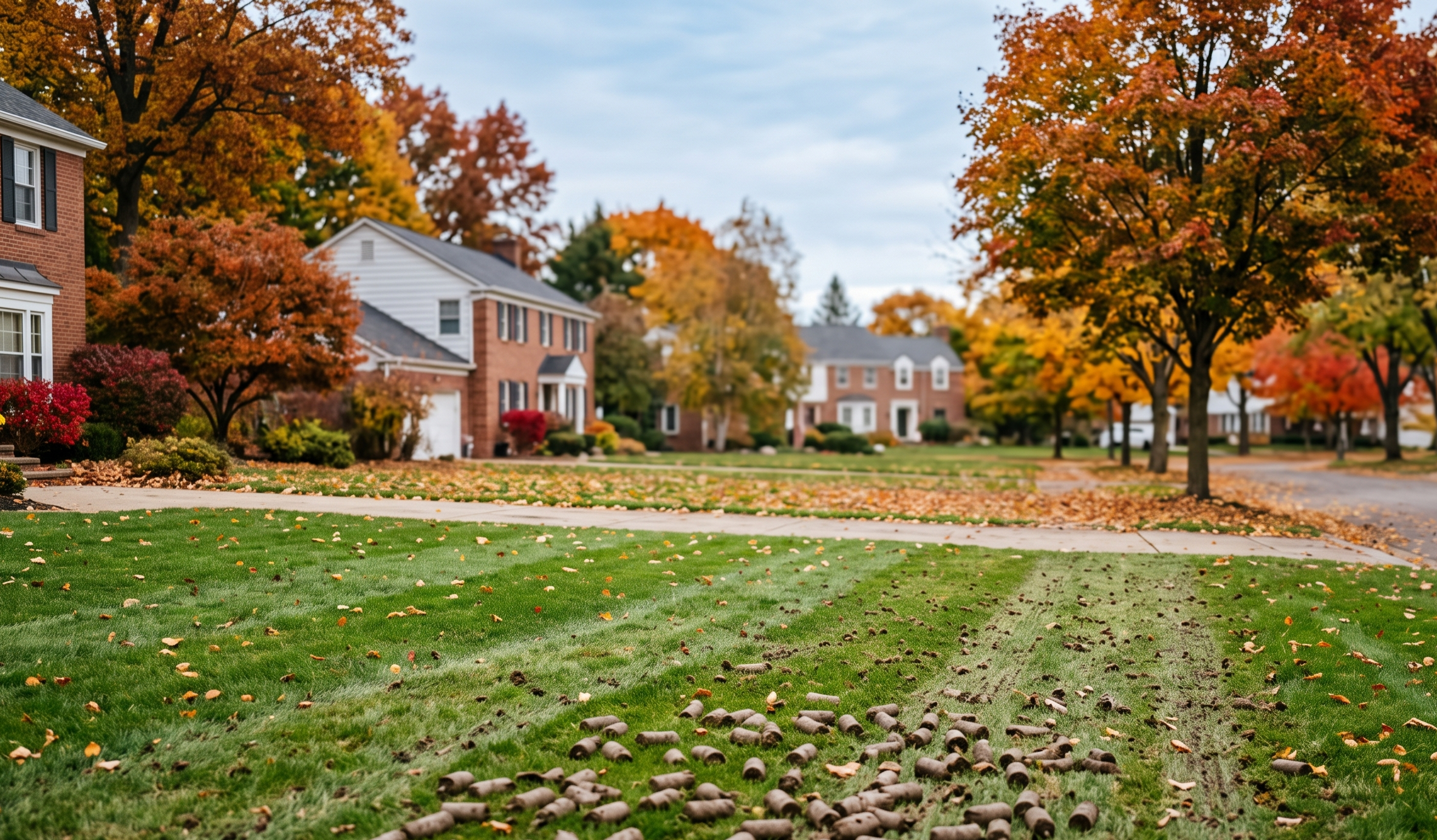
As Western New York summer fades into crisp autumn afternoons, Buffalo lawns take a heavy beating. Between intense foot traffic from summer cookouts, heavy clay soil compaction, and the upcoming toll of Lake Effect snow and freeze-thaw cycles, late summer and early autumn are critical periods for turf management. If you want a lush, thick, emerald-green lawn in Amherst, Cheektowaga, Orchard Park, or anywhere in the greater Buffalo region, late summer through early autumn is your primary window of opportunity. Core aeration and overseeding during the fall season relieve soil compaction, break down thatch layers, improve root depth for cool-season turfgrasses like Kentucky bluegrass and tall fescue, and build the resilience needed to survive brutal WNY winters.
Why Western New York Lawns Face Unique Underground Stress
To understand why mechanical aeration and overseeding are so effective in Western New York, you first have to look beneath the surface. Buffalo’s geological history leaves much of Erie and Niagara counties with dense, heavy clay soil. Clay soil consists of extremely microscopic, tightly packed mineral particles. While clay holds moisture and nutrients well, it compacts easily under foot traffic, lawnmowers, and winter snowpack.
COMPACTED CLAY SOIL (BEFORE AERATION)
+——————————————————-+
| [Grass Blades] [Weed Seeds] [Thatch Accumulation] |
|=======================================================| <- Impermeable Crust
| (Dense, Hardened Clay—Air & Water Blocked) |
| (Shallow, Stunted Root Systems) |
+——————————————————-+
CORE AERATED & OVERSEEDED SOIL (AFTER TREATMENT)
+——————————————————-+
| [Thick Turf] [New Seedling Growth] [Healthy Roots] |
|— — — — — — — — — — —|
| | | | | | | | | | <- Open Core Channels
| (Deep Air, Water & Nutrient Penetration) |
| (Root Expansion down to 6–10 inches) |
+——————————————————-+
1. The Compacted Clay Nightmare
When heavy clay becomes compacted, the microscopic pore spaces between soil particles collapse. Oxygen cannot reach the root zone, rainwater pools on top or runs off into storm drains, and turf roots are squeezed so tightly they cannot penetrate deeper than an inch or two. A shallow root system makes grass vulnerable to summer heat stress, drought, and winter kill.
2. Thatch Strangled Roots
Thatch is the spongy layer of dead roots, stems, and organic debris that builds up between green grass blades and the soil line. In healthy lawns, soil microbes break thatch down naturally. However, in compacted, oxygen-starved soils, micro-organisms die off, causing thatch to accumulate into a thick, water-repellent barrier. Thatch over 1/2 inch thick prevents water from reaching the soil and creates a warm, humid breeding ground for turf diseases like dollar spot and brown patch.
3. The Freeze-Thaw Expansion
Western New York winters bring repeated freeze-thaw cycles. When water saturated in compacted surface soil freezes, it expands, heaving and cracking root systems and damaging soil structure.
Frequently Asked Questions
Q: How can I tell if my lawn’s soil is compacted heavy clay?
A: Try pushing a standard screwdriver into your soil when it’s damp. If you can’t push it in at least 3 to 4 inches without struggling, or if rainwater pools on your lawn for hours after a rainstorm, your soil is heavily compacted.
Q: Is thatch always bad for my lawn?
A: Not in small amounts. A thin layer of thatch (under 1/2 inch) acts as insulation for root systems. It becomes a problem only when compaction starves microbes, causing thatch to thicken into a water-blocking matt.
What Core Aeration Actually Does for Your Lawn
Core aeration is the process of using a specialized mechanical aerator to pull thousands of hollow-tine soil plugs—roughly 2 to 3 inches long and 3/4 inch wide—out of the turf and deposit them on the surface.
Mechanical core aeration is completely different from spike aeration. Spike aerators simply push solid tines into the ground, which actually increases soil compaction along the sides of the hole. Core aeration physically removes soil to relieve pressure.
+——————————————————————————-+
| PRIMARY ADVANTAGES OF FALL CORE AERATION |
+——————————————————————————-+
| 1. Immediate Compaction Relief |
| Opens physical breathing tubes into the root zone, restoring oxygen |
| exchange and microbial activity. |
| |
| 2. Superior Water Filtration |
| Eliminates puddling, standing water, and surface runoff by allowing rainfall |
| to penetrate deep into the root zone. |
| |
| 3. Thatch Decomposition Acceleration |
| Deposits core plugs containing beneficial soil microbes onto the thatch |
| layer, breaking down buildup naturally. |
| |
| 4. Maximized Nutrient Intake |
| Allows autumn fertilizers and soil amendments (like lime) to reach the
| root zone directly rather than sitting uselessly on top. |
+——————————————————————————-+
Frequently Asked Questions
Q: What should I do with the soil plugs left on the ground after aeration?
A: Leave them right where they fall. Rain, irrigation, and mowing will naturally dissolve the plugs within 2 to 3 weeks, releasing beneficial microorganisms back onto the thatch layer to help break it down.
Q: Can aeration damage underground irrigation systems or invisible fences?
A: Yes, hollow tines penetrate 2 to 3 inches into the turf. Sprinkler heads, valve boxes, and shallow wiring should always be flagged before aeration begins.
Why Overseeding in Fall Changes Everything
Overseeding is the practice of spreading high-performance turfgrass seed across an existing lawn without tearing up the sod. While spring overseeding seems intuitive to many homeowners, professional turf managers in Buffalo overwhelmingly prefer fall.
Cool-Season Turf Dynamics
Buffalo turf consists entirely of cool-season grasses: Kentucky Bluegrass, Turf-Type Tall Fescue, Fine Fescue, and Perennial Ryegrass. These grass species undergo peak root growth when air temperatures hover between 60°F and 75°F and soil temperatures remain warm from the summer sun (50°F to 65°F).
Why Fall Outperforms Spring Overseeding
| Factor | Spring Overseeding | Fall Overseeding |
| Soil Temperature | Cold & wet (slow germination) | Warm & active (rapid germination) |
| Weed Competition | Extreme (crabgrass, dandelions germinating) | Minimal (broadleaf weeds dying off) |
| Pre-Emergent Collision | Herbicides kill grass seed. | No crabgrass pre-emergents needed. |
| Water Requirements | High risk of summer drought kill | Frequent autumn rain & cooler sun |
| Root Establishment Time | 1–2 months before summer heat stress | 6–8 months of root development before summer |
When you overseed in the fall, young seedlings have two full cool growing seasons—autumn and the following spring—to develop extensive root systems before facing summer heat.
Frequently Asked Questions
Q: What grass seed types work best for Western New York yards?
A: A mix of Kentucky Bluegrass (for durability and self-repair) and turf-type tall fescue (for heat and drought tolerance) works best for sunny yards. Fine fescue blends perform best in heavily shaded lawns.
Q: Why shouldn’t I overseed in spring if my lawn looks thin?
A: Spring overseeding forces young grass to compete with aggressive crabgrass and broadleaf weeds. Spring pre-emergent weed controls also block grass seeds from germinating, making fall far more effective.
The Power Combination: Core Aeration + Overseeding
While aeration and overseeding each deliver benefits independently, performing them together produces exponential results.
[AERATOR TINE]
||
\/
+———————————-+
| Pulls 2-3 Inch Soil Core |
+———————————-+
||
\/
+———————————-+
| Creates Ideal Micro-Seedbed Hole |
+———————————-+
||
\/
+———————————-+
| Seed Drops Directly into Holes |
+———————————-+
||
\/
+———————————-+
| Maximum Seed-to-Soil Contact |
| Protected from Birds & Runoff |
+———————————-+
||
\/
+———————————-+
| 80%+ Germination Success Rate |
+———————————-+
- Perfect Seed-to-Soil Contact: Seed that falls onto dense grass or un-aerated soil often fails to germinate or dries out. Aeration holes act as natural seed planters, giving seeds direct contact with moist, nutrient-rich soil.
- Built-In Protection: Seeds resting inside core holes are shielded from hungry birds, wind displacement, and heavy rain washing.
- Moisture Retention: Core cavities trap water and create high-humidity microclimates that keep germinating seeds consistently moist.
Frequently Asked Questions
Q: Can I just broadcast grass seed on top of my lawn without aerating first?
A: You can, but seed germination rates drop dramatically. Seeds lying on top of un-aerated soil or thatch struggle to establish roots, dry out rapidly, and are easily eaten by birds or washed away by rain.
Q: Do I need to cover the lawn with straw after overseeding with aeration?
A: No. The core holes created during aeration serve as miniature seedbeds, protecting seeds naturally. Straw is generally unnecessary and often introduces weed seeds into the lawn.
The Buffalo Lawn Care Calendar: When to Aerate & Overseed
Timing in Western New York is precise due to the sudden shift from early autumn weather to early frost.
AUG 15 SEP 15 OCT 01 NOV 15
|==========================|========================|========================|
PRIME WINDOW SECONDARY WINDOW TOO LATE FOR SEED WINTERIZER
- Ideal soil temp • Good germination • Frost risk to sprouts • Root storage
- Max root setup • Moisture available • Focus on aeration only • Lawn dormant
- The Prime Window (August 15 – September 20): Soil temperatures are warm, air temperatures are comfortable, and autumn rain begins. Seed germinates quickly, giving new shoots enough time to mow 2–3 times before the first hard freeze.
- The Secondary Window (September 21–October 5): Still viable for quick-germinating species like perennial ryegrass and turf-type tall fescue. Kentucky Bluegrass may struggle if frost hits early due to its 14- to 28-day germination window.
- Late Fall (October 6 Onward): Core aeration remains beneficial for soil health until the ground freezes, but overseeding success drops significantly due to frost risks.
Frequently Asked Questions
Q: What happens if a night frost hits right after I overseed?
A: Ungerminated seeds usually survive frost just fine, but once seeds sprout, tender young grass blades can be damaged or killed by heavy early freezes. That’s why completing overseeding before late September is critical in Buffalo.
Q: Can I still aerate in late October if I don’t plan on overseeding?
A: Yes! Aeration alone is highly beneficial up until the ground freezes solid, as it relieves soil compaction and opens channels for oxygen and late-season root development.
Step-by-Step Fall Turf Restoration Process
At 10xlandscaping, our Buffalo lawn maintenance specialists follow a proven agronomic process:
- Pre-Service Preparation: Mow the lawn slightly lower than normal (around 2 to 2.5 inches) and remove leaf accumulation. Mark sprinkler heads, invisible dog fences, and shallow utility lines.
- Deep Watering: Water the turf thoroughly 24–48 hours before aeration so tines pull deep, clean plugs.
- Double-Pass Mechanical Core Aeration: Walk or ride commercial core aerators across the property in cross-hatch patterns to guarantee high hole density per square foot.
- Custom Seed Blend Distribution: Apply a premium cool-season seed mix suited to your property’s sunlight levels (e.g., Kentucky Bluegrass/Perennial Ryegrass for sunny yards, Fine Fescue blends for shaded properties).
- Starter Fertilizer & Soil Amendment Application: Apply a high-phosphorus starter fertilizer to accelerate root growth along with pelletized lime if soil testing indicates acidic pH levels.
- Post-Care Watering Schedule: Keep the top 2 inches of soil consistently moist with light waterings 2–3 times per day until seedlings reach 2 inches tall.
Frequently Asked Questions
Q: How long does it take for new grass seed to sprout after overseeding?
A: Perennial ryegrass germinates in 5 to 7 days, turf-type tall fescue takes 7 to 14 days, and Kentucky bluegrass takes 14 to 21 days depending on soil moisture and temperatures.
Q: When is it safe to resume normal mowing after fall overseeding?
A: Wait until new grass seedlings reach 3.5 to 4 inches tall. Mow with sharp blades so you slice the grass cleanly rather than tearing fragile young plants out by their roots.
📍 Local Lawn Aeration & Overseeding Service Areas Near Me
If you are searching for lawn aeration near me or professional overseeding near me in Western New York, 10x Landscaping provides full-service local turf restoration across Erie and Niagara counties. Whether your home sits on hard-packed clay in Amherst or needs deep root rejuvenation in Orchard Park, our local field crews bring commercial-grade machinery directly to your neighborhood.
+——————————————————————————-+
| WESTERN NEW YORK SERVICE BOUNDARIES |
+——————————————————————————-+
| Erie County Coverage: |
| Buffalo | Amherst | Cheektowaga | Orchard Park | Clarence | West Seneca |
| Williamsville | Hamburg | Lancaster | East Aurora | Grand Island | Tonawandas |
| |
| Niagara County Coverage: |
| Lockport | North Tonawanda | Wheatfield | Pendleton | Niagara Falls |
+——————————————————————————-+
Frequently Asked Questions
Q: How quickly can 10x Landscaping dispatch a team for lawn aeration near me in Buffalo?
A: We schedule services during the optimal mid-August through late-October window. You can secure your slot online or by phone for priority dispatch in your neighborhood.
Q: Do you service both residential properties and commercial facilities in WNY?
A: Yes! We provide core aeration, overseeding, and soil management for single-family residential lawns, HOA communities, and commercial office parks throughout Erie and Niagara counties.
🏢 Interactive Google Business Profile & Service Location
Explore our service area map below to confirm local coverage and access verified customer feedback:
Transform Your Lawn with 10x Landscaping
Don’t let another Western New York winter weaken your turf. Investing in professional fall aeration and overseeding gives your lawn the strength, root depth, and density needed to withstand harsh weather and return thicker and greener every spring.
Ready for a thicker, healthier lawn next spring?
Contact the local experts at 10xlandscaping today to schedule your fall aeration and overseeding service in Buffalo, NY, and surrounding Western New York communities!
Frequently Asked Questions
Q: How much does professional fall aeration and overseeding cost in Buffalo?
A: Pricing depends on square footage, property layout, and seed selection. 10x Landscaping provides customized, transparent quotes for properties across Western New York.
Q: How far in advance should I book my fall service?
A: The Buffalo fall window is short (mid-August through late September). Booking by mid-summer ensures your spot on the calendar during the peak germination window.