


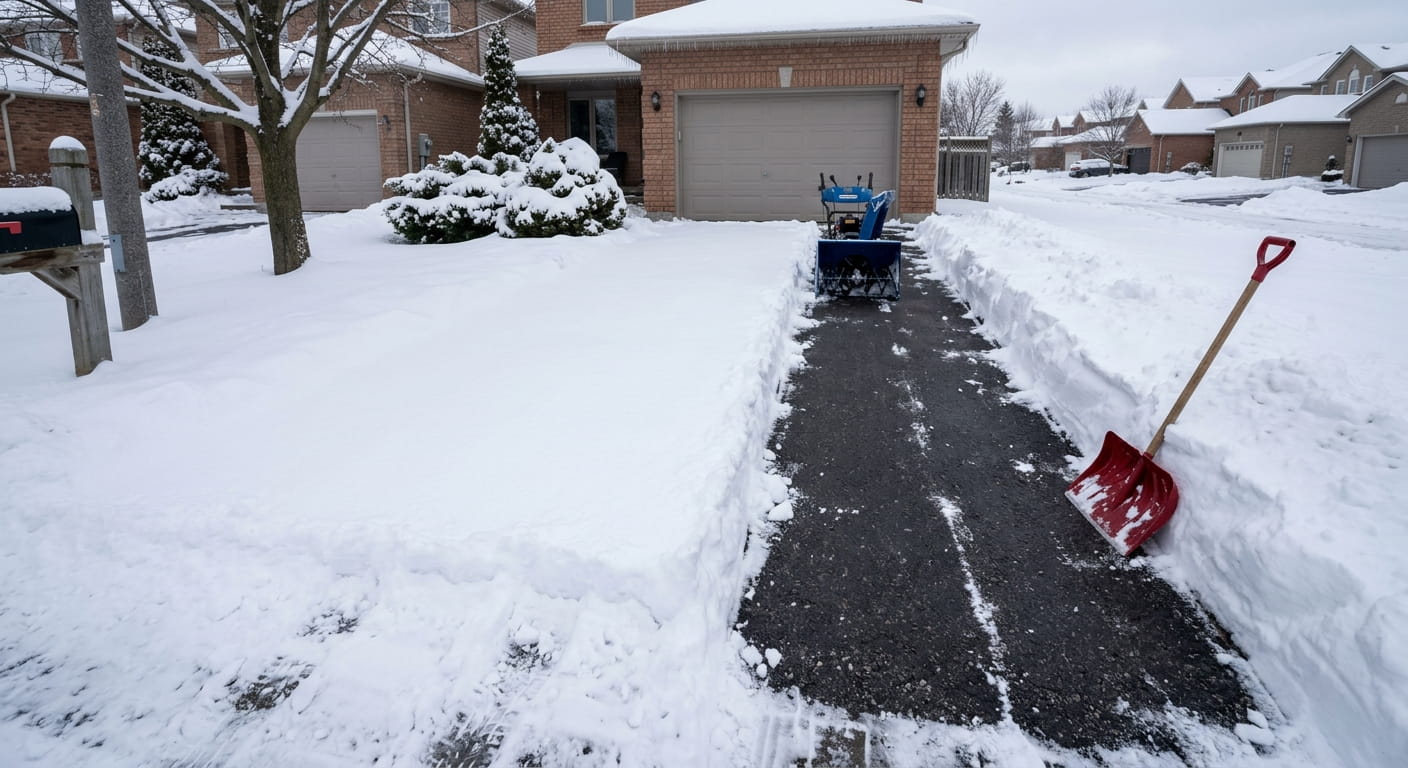
Every April, the phone calls start sounding the same. The snowbanks finally melt, a homeowner in Orchard Park or West Seneca walks down their driveway for the first time in months, and they see it: long grey scrape lines, a chewed-up edge by the lawn, maybe a chunk of asphalt sitting in the grass. The first thought is almost always, “The plow did this.”
Sometimes it did. More often, the plow just gets blamed for something winter itself caused. At 10x Landscaping & Snow Plowing Service, we plow residential driveways and commercial lots across Buffalo and the surrounding Erie County towns, and we’ve spent a lot of spring mornings walking properties with owners, figuring out what actually happened. This guide shares what we’ve learned, in plain language, so you can tell real plow damage from winter wear and protect your driveway before the first lake-effect band rolls in off Lake Erie.
Does Snow Plowing Damage a Driveway? The Honest Answer
A snow plow can damage a driveway, but it shouldn’t if the equipment is set up right and the operator knows the property. A plow blade is designed to ride on top of the pavement and push snow, not dig into it. On a healthy asphalt or concrete driveway, a well-adjusted blade leaves little more than light surface scuffing, which usually fades by summer.
Real damage happens when something in that equation is off: the wrong blade edge for the surface, too much down pressure, a driveway that has already heaved or cracked, or an operator who can’t see where the pavement ends under two feet of snow. The good news is that almost all of those risks can be reduced with a little planning before winter starts.
What Actually Causes Plow Marks on a Driveway
When we inspect a driveway after a complaint, the marks almost always trace back to one of the causes below. Knowing which one you’re looking at tells you whether it’s a plowing problem, a pavement problem, or both.
1. A steel cutting edge on bare pavement
Most commercial plows run a steel cutting edge along the bottom of the blade because steel scrapes hard-packed snow and ice cleanly. On a big parking lot, that’s exactly what you want. On a residential driveway, especially one with older or softer asphalt, a steel edge dragged over pavement with little snow cover can leave the classic grey scrape lines homeowners notice in spring. These are usually cosmetic, but on worn asphalt they can loosen the top layer of stone over time.
2. Too much down pressure, or plowing too close to bare
Some plows let the operator push the blade down harder to get a “cleaner” scrape. That can help on ice, but on a driveway it concentrates the weight of the blade on the pavement surface. Combine that with a light one- or two-inch snowfall, and the blade is basically sanding your driveway. An experienced operator adjusts for the conditions instead of using the same setting on every property.
3. Gravel, stone, and paver driveways plowed like asphalt
Gravel driveways are common in parts of Clarence, East Aurora, and the rural edges of Erie County. If a plow runs with the blade flat on a gravel surface, it pushes the stone into your lawn along with the snow. The fix is using plow shoes (sometimes called skid shoes) that hold the blade slightly off the surface. Pavers have a similar risk: a blade catching one raised paver edge can pop it loose or chip it.
4. Heaved slabs, raised joints, and crumbling edges
This is the big one in Western New York. Many WNY neighborhoods sit on clay-heavy soil that holds water, and when that water freezes under a driveway it can lift a concrete slab or push up a section of asphalt. When a blade traveling at a steady pace hits a raised lip, even by half an inch, something has to give. Usually it’s the lip. The plow didn’t create the weakness, but it found it.
Driveway edges work the same way. Asphalt edges without proper base support tend to crumble, and a blade clipping that edge can break off pieces that were already loose.
5. Fresh sealcoat or new asphalt that hasn’t cured
If your driveway was paved or sealcoated late in the fall, the surface may still be relatively soft when the first storm hits. Blade edges and even tire turning can leave marks in that surface. That’s why the timing of fall sealcoating matters, and why you should always tell your plow contractor about new work.
Are scrape marks from a plow permanent?
Light scuffing on healthy asphalt usually fades with sun and traffic by early summer. Deeper gouges, chipped edges, or lifted pavers need repair.
Can a plow crack my driveway?
A plow rarely cracks a solid driveway on its own. Cracks usually come from water and freeze-thaw; a blade can break off pieces around existing cracks or raised edges.
Does plowing a gravel driveway ruin it?
Not if the blade is raised with shoes. Plowing gravel with the blade flat on the ground is what scatters stone into the lawn.
Winter Damage That Looks Like Plow Damage (But Usually Isn’t)
A lot of what homeowners find in spring has nothing to do with the plow. Buffalo winters are hard on pavement in ways that are easy to misread.
Freeze-thaw cracking
Western New York swings above and below freezing again and again between November and April. Every time water in a small crack freezes, it expands and pushes the crack wider. The National Weather Service in Buffalo describes our winters as cold and snowy but changeable, with frequent thaws and rain mixed in, and notes that the Southtowns get far more lake-effect snow than the northern suburbs. That constant back-and-forth is exactly what opens up cracks. Cracks that seem to “appear” over winter usually started as hairline cracks in the fall that freeze-thaw opened up. If you’d like to understand the bigger picture of how storm frequency affects your driveway, our guide on how often a driveway should be plowed covers that in detail.
Salt scaling on concrete
If the top of your concrete driveway is flaking or pitting in patches, that’s usually scaling, not plow damage. It happens when de-icing salt and freeze-thaw cycles work together on the concrete surface, and it’s more common on newer concrete (roughly the first year) or concrete that was never sealed. Some de-icers are harsher than others, which is why the choice of salt matters as much as the plowing. Concrete industry guidance, like this de-icer guide from the Pennsylvania Aggregates and Concrete Association, recommends skipping de-icers on concrete during its first year. One rule has no exceptions: never use products containing ammonium nitrate or ammonium sulfate. They’re sometimes sold as ice melt, but they’re fertilizers that chemically attack concrete and can ruin the surface in a single season.
Edge breakup from water under the pavement
When water gets under the edge of an asphalt driveway, usually because the edge sits lower than the lawn or the downspout drains toward it, the base softens. Add winter traffic and snow weight from the bank piled next to it, and the edge crumbles. A plow might knock the final pieces off, but the cause is drainage.
How to tell the difference
- Plow damage is usually straight and directional: parallel scrape lines, gouges that follow the path of the truck, or chips at the exact spot where a blade meets a raised edge.
- Winter wear is usually random or spread out: spiderweb cracking, flaking patches, or edges crumbling along a long stretch.
- Tire marks are rounded and paired, often at the end of the driveway where the truck turns.
Does rock salt damage driveways?
Rock salt can speed up scaling on concrete, especially newer concrete, and it’s tough on nearby lawns and plants. Asphalt handles it better, but no de-icer is completely harmless. Avoid anything containing ammonium nitrate or ammonium sulfate entirely.
Why do new driveways get damaged more in winter?
New concrete and freshly laid or sealed asphalt need time to cure and harden. A first winter is when they’re most vulnerable to salt and blade contact.
Worried about your driveway this winter?
10x Landscaping & Snow Plowing Service offers a free pre-season walkthrough for Buffalo-area driveways.
- Mark your edges
- Note trouble spots
- Set up for your surface
How Plowing Affects Different Driveway Surfaces
Not every driveway reacts the same way to a plow. Here’s how we think about the common surfaces we see around Buffalo, Amherst, Hamburg, and Orchard Park.
| Surface | Main plow risk | What helps |
|---|---|---|
| Asphalt | Scrape lines, loose edges, marks in fresh sealcoat | Adjusted down pressure, solid edges, fall crack sealing, sealcoat timed well before first freeze |
| Concrete | Chipping at raised joints or heaved slabs | Mark and flag heaved sections, repair lifts in fall, gentler de-icers |
| Pavers | Blade catching a raised paver edge | Poly or rubber edge, blade slightly raised, releveled pavers before winter |
| Gravel / stone | Stone pushed into lawn, ruts | Plow shoes to lift blade, leave a thin snow base, avoid scraping to bare |
Rubber vs Steel vs Poly Plow Edges: What’s Best for a Driveway?
One of the best questions you can ask a snow plow contractor is, “What cutting edge do you run on residential driveways?” It tells you a lot about how much they think about your pavement.
| Cutting edge | Strengths | Trade-offs |
|---|---|---|
| Steel | Scrapes packed snow and ice cleanly; long lasting; the commercial standard | Hardest on pavement; more likely to leave marks on older asphalt, pavers, and decorative concrete |
| Rubber | Gentle on surfaces; quieter; flexes over small bumps | Leaves a thin layer of snow behind; less effective on hard-packed ice |
| Polyurethane (poly) | Middle ground; kinder to pavement than steel with better scraping than rubber | Costs more; still needs proper blade setup |
There’s no single “right” answer. A commercial parking lot that needs to be scraped close to bare for safety is a different job from a new stamped concrete driveway in Clarence. The right contractor matches the equipment to the surface and explains why. The Snow & Ice Management Association’s best practices, the main professional group for the snow industry, puts a lot of emphasis on this kind of site-specific planning.
Is a rubber plow edge better for driveways?
Rubber is gentler on pavement, especially pavers and decorative concrete, but it won’t scrape hard ice as well. Many contractors pair a softer edge with salting or de-icing to finish the job.
Should I ask my plow company what blade they use?
Yes. A good contractor will tell you what edge they run and how they adjust it for your driveway.
How to Protect Your Driveway From Plow Damage Before Winter
Most driveway damage is decided in October and November, not in February. Here’s the short version of the checklist we give our own customers. For the full season-long plan, see our winter driveway protection guide.
- Install driveway markers before the ground freezes. Fiberglass snow stakes or reflective driveway markers along both edges show the operator exactly where the pavement ends. Once the ground is frozen in December, getting them in is much harder. Place them every 10 to 15 feet, plus at every corner and curve.
- Flag every obstacle. Mark sprinkler heads, low landscape lights, decorative borders, mailbox posts, and any drainage grates near the driveway. What you can see in October disappears under the first real snowfall.
- Fix cracks and heaves in the fall. Sealing cracks before winter keeps water out, which slows freeze-thaw damage. Grind or repair raised concrete lips so a blade can ride over them cleanly.
- Time your sealcoating carefully. Sealcoat needs warm, dry weather to cure properly. In Buffalo, that usually means getting it done by early fall rather than squeezing it in right before the first frost.
- Tell your plow contractor about anything new. A new driveway, new pavers, fresh sealcoat, or a soft spot you’ve noticed are all things an operator needs to know before the season starts.
- Choose de-icer on purpose. For newer concrete especially, ask your contractor which products they use and whether they can avoid harsher salts on your surface.
- Do a walkthrough with your contractor. Ten minutes on your driveway in the fall prevents most spring surprises. It’s also a great time to ask the questions in our guide on what to ask a snow removal contractor.
When should I put in driveway markers in Buffalo?
Ideally in October or early November, before the ground freezes. Once there’s frost in the ground, stakes are hard to drive in and easy to break.
How 10x Landscaping & Snow Plowing Service Plows to Protect Your Surface
We’ve been clearing snow in Buffalo and the surrounding towns for more than five years, and one thing we’ve learned is that “fast” and “careful” don’t have to be opposites. Here’s how our crew approaches driveway plowing:
- Pre-season property walk. Before the season starts, we look at your surface, note heaved sections, soft edges, gravel areas, and obstacles, and make sure markers are in place.
- Equipment matched to the job. Our residential setup is adjusted differently from our commercial lot setup. Gravel driveways get the blade raised, and newer or decorative surfaces get a lighter touch.
- Consistent operators on consistent routes. When the same crew plows your driveway storm after storm, they learn exactly where the edges, dips, and trouble spots are.
- Smart snow piling. We stack snow where it won’t melt back across your driveway and refreeze overnight, and away from edges that are already fragile.
- Salting and de-icing on request. We can talk through product options that are easier on newer concrete.
Whether you need a single residential driveway cleared or a full commercial property, you can see the details on our snow plowing services page or our broader snow removal services in Buffalo. If budget is part of your decision, our snow removal cost guide and our breakdown of seasonal contracts vs per-visit plowing are good next reads.
Get careful, consistent snow plowing in Buffalo.
10x Landscaping & Snow Plowing Service serves Buffalo, Orchard Park, Hamburg, West Seneca, Amherst, Cheektowaga, and nearby Erie County communities. Seasonal routes fill up fast once the first storm hits.
What to Do If You Find Plow Damage in the Spring
If you walk your driveway after the melt and find something that looks like plow damage, here’s a calm, practical way to handle it.
- Take clear photos with something in the frame for scale, like a shoe or a tape measure. Photograph the whole driveway, not just the damaged spot.
- Look at the pattern. Straight, directional scrapes and fresh chips at raised edges point to the plow. Random cracking, flaking, and long crumbling edges point to winter wear.
- Contact your contractor early. A reputable company would rather hear about it in April than find out from a review in July. Walk the driveway together if you can.
- Check your agreement. Your snow contract or service terms should explain how property damage concerns are handled. If you don’t have anything in writing, that’s worth fixing before next season.
- Repair before next winter. Small edge chips and cracks grow every freeze-thaw cycle. Sealing or patching in late spring or summer stops next winter from making them worse.
Frequently Asked Questions About Snow Plowing and Driveway Damage
Does snow plowing damage asphalt driveways?
Plowing can leave light scrape marks on asphalt, especially older or recently sealed surfaces, but serious damage is uncommon when the blade is adjusted properly and the edges are marked. Most asphalt damage in Buffalo comes from water and freeze-thaw.
Is it better to shovel or plow to protect a driveway?
Shoveling is gentler, but it’s not realistic for most Buffalo storms or long driveways. Professional plowing with proper setup is safe for most surfaces, and leaving snow on the driveway causes its own problems through melting and refreezing.
Can a plow damage my lawn next to the driveway?
Yes, if the operator can’t see the edge. Lawn gouges near the driveway are one of the most common spring complaints, and driveway markers prevent most of them.
How do I choose a snow plow company that won’t damage my driveway?
Ask about their equipment, whether they do a pre-season walkthrough, whether they use consistent operators, and how they handle damage concerns. A company that answers those questions clearly is a good sign.
Should I plow a new driveway in its first winter?
Yes, snow still needs to come off, but tell your contractor it’s new. They can adjust blade pressure and avoid harsher de-icers to protect the fresh surface.
The Bottom Line
Snow plowing itself isn’t the enemy of your driveway. Poor setup, unmarked edges, and surfaces that were already weakened by Buffalo’s freeze-thaw winters are what leave the marks. A few simple steps in the fall, combined with a contractor who adjusts to your surface instead of treating every property the same, will keep your driveway in good shape through even the heaviest lake-effect season.
If you’d like a crew that treats your driveway like it’s their own, 10x Landscaping & Snow Plowing Service is ready to help. For more on how we work, see our complete snow plowing guide.
Let’s protect your driveway.
Schedule your free pre-season walkthrough with 10x Landscaping & Snow Plowing Service. Serving Buffalo, NY and surrounding Erie County towns.