


Every year, as the final winter snowbanks melt away from the Niagara Frontier, homeowners across Western New York experience the exact same realization at the exact same time: it is finally time to get outside. Almost overnight, local landscape crews are booked out for months, supply chains for premium pavers tighten up, and nursery stock gets picked over. If you wait until the first 60-degree day in April to pick up the phone, you are already running behind. True Buffalo landscape planning is an exercise in strategic timing; the secret to achieving your dream outdoor living space is starting the collaborative design process while the ground is still frozen.
By stepping out of the frantic spring rush and engaging in late winter or early spring planning, you grant yourself the luxury of time. You get first pick of construction schedules, unhurried design revisions, and guaranteed access to materials. Let’s break down how early planning transforms a stressful home improvement project into a seamless, high-value investment for your property.
1. The Reality of the WNY Landscaping Timeline
Western New York has one of the shortest, most intense construction seasons in the country. Our unique climate dictates a rigid operational window that local property owners must navigate carefully.
[Dec – Feb] ——–> [March – April] ——-> [May – October] ——-> [November]
Design & Permits Material Sourcing Active Construction Winterization
Our active construction window typically spans from May through October. That gives local crews roughly six months to execute an entire year’s worth of structural retaining walls, custom patios, outdoor kitchens, and complex drainage systems.
When you factor in spring rain delays and the sheer volume of homeowners requesting quotes simultaneously in May, a backlog forms instantly. A design initiated in late spring often cannot be broken ground on until late August or September. By starting the blueprinting process months in advance, your project moves to the front of the queue, ensuring your crew arrives the moment the ground is dry enough to excavate safely.
Frequently Asked Questions
Q: When is the absolute best month to contact a Buffalo landscaper for a spring project?
A: January or February. Initiating contact during the winter ensures your design is finalized and permitted before the ground thaws, placing you at the front of the construction line.
Q: How long does the typical landscape construction phase last in WNY?
A: Small to mid-sized projects (patios, plantings) take 1–2 weeks, while major multi-tier backyard transformations can take 3–6 weeks of active onsite work.
2. Why Early Design Beats the Spring Delays
Landscape architecture is not a commodity you can buy off a shelf; it is an iterative, creative process. Rushing through the conceptual phase to “just get it done” almost always leads to compromises you will regret later.
Unhurried Design Fluidity
When you collaborate with a design-build firm in January or February, you have the designer’s undivided attention. You can explore multiple concepts, adjust layout orientations, test different material swatches, and truly deliberate on how you want your family to use the space. Once the spring rush hits, designers are pulled in a dozen directions at once, naturally compressing the time they can dedicate to fine-tuning your specific layout.
Streamlined Permitting and HOA Approvals
Major transformations—like building an outdoor kitchen, installing structural retaining walls, or erecting a custom pavilion—require permits from local municipalities, whether you live in Amherst, Orchard Park, Clarence, or the City of Buffalo.
- Town Hall Backlogs: Building departments get slammed in the spring. A permit application that takes two weeks to process in February might take six to eight weeks in May.
- HOA Reviews: Homeowners’ associations frequently meet only once a month. Missing a submission deadline because your design wasn’t finalized can push your start date back by a full thirty days.
Frequently Asked Questions
Q: Do I need a town permit for a basic paver patio in Erie County?
A: It varies by town. Property line setbacks and impervious surface ratios dictate permit requirements in towns like Amherst and Orchard Park. A professional designer handles these checks during the winter phase.
Q: What happens if my HOA rejects my landscape design layout?
A: Winter planning allows time for revisions. If a design is rejected in February, it can be modified and resubmitted for the March meeting without delaying your spring build date.
3. Material Sourcing: Securing Premium Products
The supply chain dynamics of the outdoor living industry taught local contractors a permanent lesson: early ordering wins.
Early Planning (Winter/Early Spring) Late Planning (Late Spring/Summer)
┌──────────────────────────────────────┐ ┌──────────────────────────────────────┐
│ ✓ Full access to stone catalogs │ │ ✗ Settlement for second-choice color│
│ ✓ Reserved premium nursery stock │ │ ✗ Extended manufacturer lead times │
│ ✓ Locked-in off-season pricing │ │ ✗ Higher shipping & logistics costs │
└──────────────────────────────────────┘ └──────────────────────────────────────┘
When you finalize your material selections early, your contractor can place orders with regional distributors long before the seasonal demand peaks.
- Hardscape Materials: Premium concrete pavers, natural flagstone, and structural wall blocks from top manufacturers have finite production runs. If a specific colorway or texture sells out in April, you could face multi-week manufacturer lead times.
- Specimen Plantings & Trees: The most robust, beautifully formed privacy trees (like Green Giant Arborvitae) and unique specimen shrubs are claimed by proactive contractors early in the year. Waiting until spring means picking through the remnants at local wholesale yards.
Frequently Asked Questions
Q: Can I lock in last year’s pricing by ordering hardscape supplies early?
A: Yes. Many design-build firms offer off-season procurement options that protect you from the annual price increases manufacturers roll out every spring.
Q: What materials face the longest delays if ordered late in the season?
A: Custom natural stone profiles, high-end outdoor kitchen appliances, and premium porcelain tiles consistently see extended lead times by early summer.
4. Designing for the Buffalo Climate
Designing a landscape in Western New York requires a deep understanding of our unique microclimates and soil conditions. We aren’t just building for the beautiful summer months; we are building to survive the punishing winters.
The Frost Heave Factor
The freeze-thaw cycle in the Buffalo-Niagara region is incredibly harsh. The ground freezes deep, expands, and then thaws, creating massive upward pressure on horizontal surfaces.
The Structural Standard: Any patio or retaining wall built in WNY requires an over-engineered aggregate base. While standard industry practice in milder climates might dictate a 4-to-6-inch gravel base, our regional soils require a minimum of 8 to 12 inches of compacted crushed stone, coupled with heavy-duty geotextile fabric to prevent subgrade soil mixing.
Addressing Heavy Clay and Drainage
From the heavy clay soils of Hamburg to the high water tables near the lakeshores, drainage is the foundational element of every successful WNY landscape project.
[Surface Runoff / Rain / Snowmelt]
│
▼
┌─────────────────────────────────────┐
│ Permeable Paver Joints (Infill) │
└─────────────────────────────────────┘
│
▼
┌─────────────────────────────────────┐
│ Open-Graded Stone Base (Bedding) │
└─────────────────────────────────────┘
│
▼
┌─────────────────────────────────────┐
│ Perforated French Drain / Sub-Base │ ──► [ Diverted safely away
└─────────────────────────────────────┘ from the Home Foundation]
During the spring thaw, massive volumes of snowmelt have nowhere to go because the lower levels of soil remain frozen. Early planning allows us to calculate proper grading pitches, design hidden French drain networks, and integrate permeable paver systems that channel water completely away from your home’s foundation.
Frequently Asked Questions
Q: Why do brick patios in Buffalo shift and get wavy over time?
A: Shifting occurs when the underlying stone base is too shallow or lacks proper drainage. Water trapped beneath the pavers freezes, expands, and pushes the stones upward unevenly.
Q: What is a permeable paver system, and why is it beneficial for WNY?
A: Permeable systems feature wider joints filled with small stone aggregate, allowing heavy spring rain and snowmelt to filter straight down into the sub-base rather than pooling on your lawn or flooding your basement.
5. Elevating Your WNY Outdoor Living Experience
Modern backyards are seamless extensions of the home’s interior floor plan. When planning your layout, consider how these high-value features can be customized to maximize our regional season.
Custom Patios and Hardscapes
Your patio is the anchor of your outdoor living environment. Integrating multiple levels or distinct “rooms”—such as a dedicated dining zone laid with clean, modern linear pavers alongside a relaxed lounge space finished in rustic natural flagstone—creates visual interest and functional clarity.
Extended-Season Features
Because our summers are precious, extending the usability of your outdoor space into the crisp autumn months is a top priority for WNY homeowners.
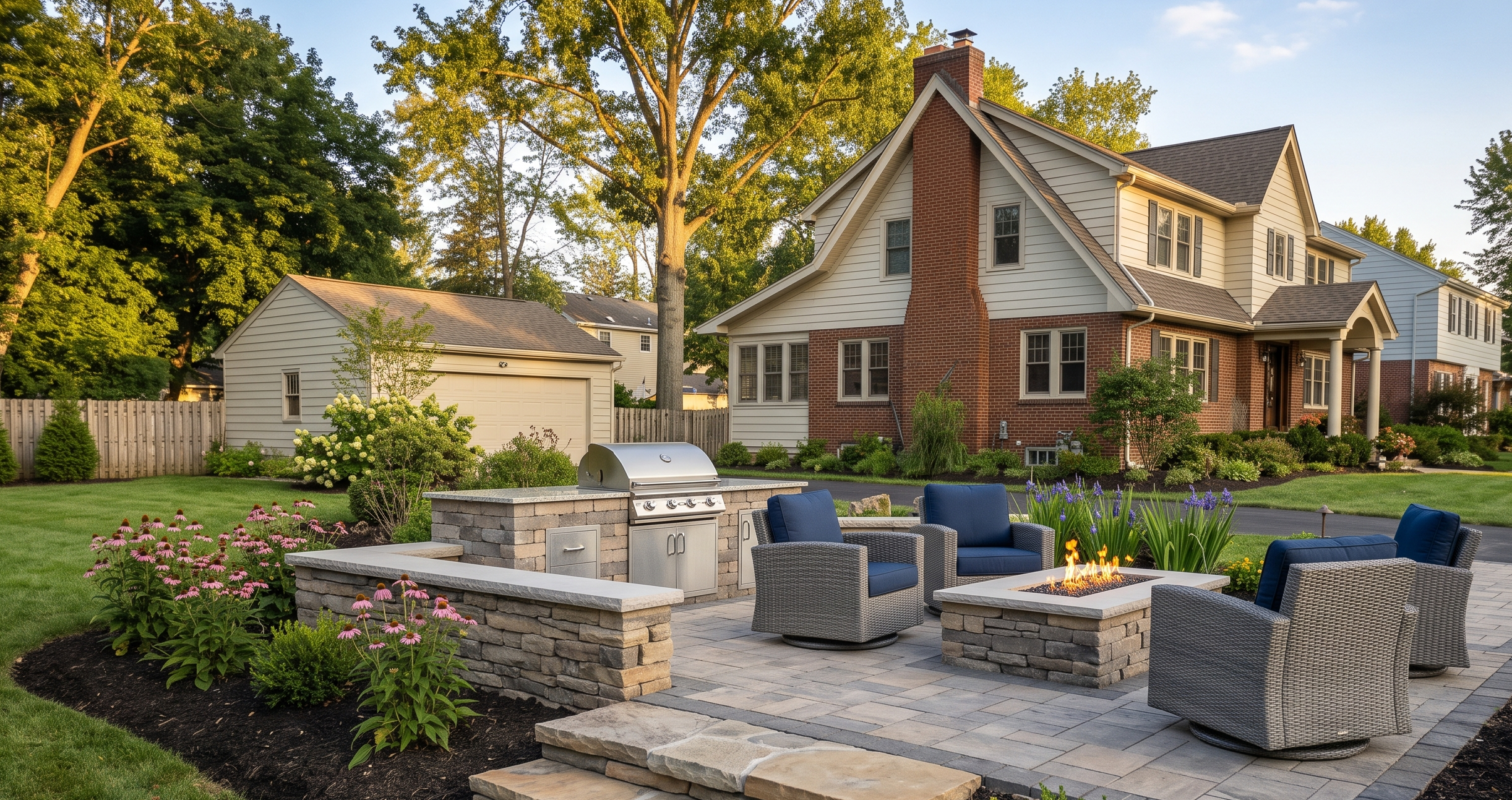
- Outdoor Fireplaces & Fire Pits: A custom natural gas fire table or a massive wood-burning stone fireplace acts as a natural gathering point, allowing you to comfortably enjoy your backyard from early April all the way through Thanksgiving.
- Outdoor Kitchens: Equipped with built-in marine-grade stainless steel grills, granite countertops, and outdoor refrigeration, a fully realized outdoor kitchen eliminates the constant trips back and forth to your indoor stove, keeping the chef entirely in the action.
Frequently Asked Questions
Q: Is a natural gas or a wood-burning fire pit better for a Buffalo backyard?
A: Natural gas offers instant heat with zero smoke, making it perfect for quick evening use. Wood-burning units offer higher heat output, which is great for late-autumn nights, but require dedicated wood storage protected from damp WNY weather.
Q: Can outdoor kitchen countertops withstand freezing winter snow?
A: Yes, if you use high-density granite or natural quartzite paired with proper winter covers. Avoid manufactured quartz, which can crack under intense UV exposure and extreme temperature swings.
6. Native Plantings: Beauty That Endures
A truly great landscape design balances the structural permanence of hardscaping with the soft, fluid movement of living plants. Selecting species that thrive in USDA Hardiness Zones 5 and 6 ensures your garden remains vibrant year after year without demanding constant maintenance.
| Plant Classification | Recommended Species for WNY | Landscape Function |
| Deciduous Trees | Autumn Blaze Maple, River Birch | Stunning fall color, architectural bark texture |
| Evergreen Screening | Techny Arborvitae, Canadian Hemlock | Year-round privacy, excellent windbreaks |
| Flowering Shrubs | Incrediball Hydrangea, Witherod Viburnum | Massive summer blooms attract local pollinators |
| Perennial Highlights | Purple Coneflower, Blue Flag Iris | Drought-tolerant once established, rich color returns annually |
Integrating native perennials and robust cold-hardy shrubs guarantees that your gardens will emerge from the heavy winter snows ready to push out lush, healthy new growth every single spring.
Frequently Asked Questions
Q: Can I plant new trees during a late spring landscape installation?
A: Absolutely. Spring is an ideal planting window because the consistent rainfall and mild temperatures allow root systems to establish before the summer heat hits.
Q: How do I protect expensive landscape plants from local deer populations?
A: The most reliable solution is selecting naturally deer-resistant species like boxwoods, ornamental grasses, and purple coneflowers during the early design phase.
7. Proximity Focus: Premier WNY Landscaping Services Near Me
If you are currently searching for premium, reliable landscaping services near me anywhere across Erie or Niagara County, timing your architectural layout is the exact variable that determines how fast your project goes from concept to reality. Proximity to a trusted, highly rated crew matters, but securing a slot with an enterprise capable of executing advanced drainage, grading, and complex hardscaping is paramount.
Our local landscape crews intimately understand the regional municipal guidelines, frost schedules, and specific neighborhood setbacks across the entire Western New York footprint, routinely deploying custom design-build services to our neighbors in:
- The Northtowns: Providing dedicated residential transformations across Amherst, Clarence, Williamsville, Kenmore, and Tonawanda.
- The Southtowns: Designing and building custom hardscapes throughout Orchard Park, Hamburg, East Aurora, and West Seneca.
- The Metro & Surrounding Zones: Managing local properties within the City of Buffalo, Cheektowaga, and Lancaster.
By grouping local project logistics by these key WNY zones, our operations stay highly efficient, passing down speed, coordination, and structural accountability straight to your front yard.
Frequently Asked Questions
Q: Do you offer landscape design consultations across the entire Buffalo-Niagara region?
A: Yes. A professional design-build team travels out directly to properties across both the Northtowns and Southtowns to conduct comprehensive site evaluations, elevations, and soil assessments before drawing up your custom layout blueprints.
Q: How do local soil variations between the Northtowns and Southtowns affect design?
A: Areas like Hamburg often feature denser clay, requiring deeper aggregate sub-bases and dedicated drainage tile routing, whereas parts of Clarence may require specific machinery to handle shallow bedrock profiles cleanly.
8. Choosing the Right Design-Build Partner
Transforming your property is a significant financial investment, and the team you choose to execute it matters immensely. When interviewing local landscape firms during the planning phase, look for these markers of professional credibility:
- Design-Build Capabilities: Hiring a single firm that handles both the architectural design phase and the physical construction phase ensures absolute continuity. The person drawing the prints is in direct communication with the crew operating the excavators, eliminating costly miscommunications.
- Local Portfolio Depth: Ask to see completed projects within your specific municipality. A firm that regularly builds in your town will already be intimately familiar with local zoning laws, setback requirements, and specific soil profiles.
- Comprehensive Warranties: Reputable contractors stand behind their craftsmanship. Look for companies that offer multi-year structural warranties on hardscape installations and clear establishment guarantees on newly planted nursery stock.
By securing your design-build partner during the off-season, you form a collaborative relationship built on clear communication, meticulous preparation, and a shared vision. When the spring sun finally breaks through the clouds, you won’t be waiting on return phone calls—your project will already be cleanly underway.
Frequently Asked Questions
Q: What is the primary difference between a landscape designer and a landscaper?
A: A designer focuses on space planning, structural engineering blueprints, and material aesthetics. A standard landscaper typically handles routine maintenance like mowing and mulching. A design-build firm merges professional planning with heavy construction execution.
Q: Do local firms require the entire project payment upfront?
A: No. Reputable firms operate on structured draw schedules—typically a small design deposit, a percentage down to secure a slot and order materials, and milestone payments as physical construction milestones are cleared.