


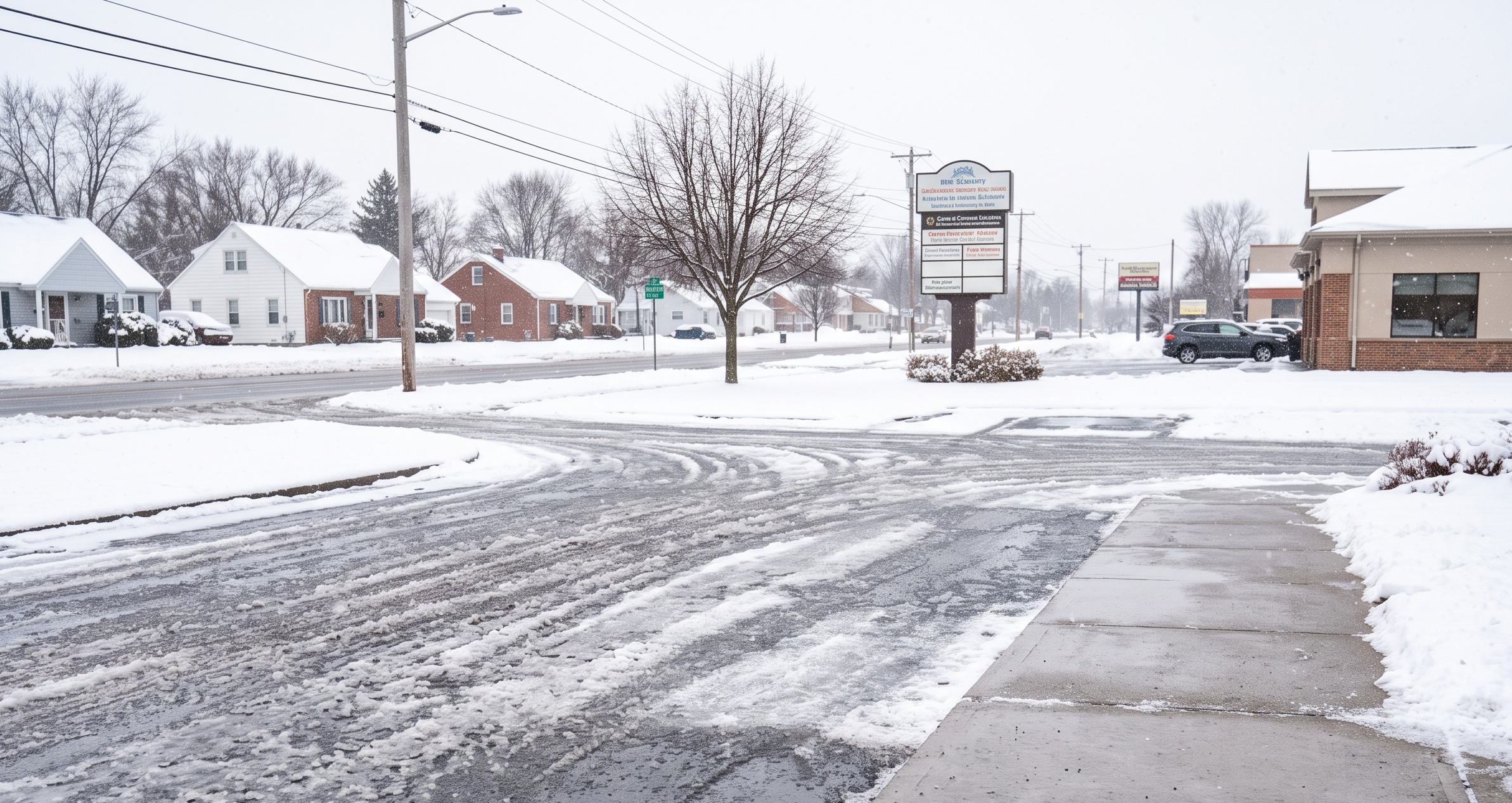
Living in Western New York means embracing a true winter wonderland. But as anyone from the Buffalo-Niagara region knows, our lake-effect snowstorms and sudden freeze-thaw cycles bring a unique set of structural and safety challenges. When a storm hits the Queen City, clear driveways, walkways, and commercial parking lots are not just a matter of aesthetics—they are a critical safety imperative.
Managing winter weather effectively requires moving beyond the traditional method of tossing down a handful of rock salt after the ice has already bonded to the pavement. True winter safety relies on the chemistry and physics of de-icing. By understanding the science behind ice mitigation and applying specific localized standards, property owners can protect their surfaces, reduce liability, and keep everyone safe.
1. The Physics and Chemistry of De-Icing: How It Works
To manage ice effectively, we must first understand how it forms and how different chemical compounds interact with it. De-icing isn’t actually about “melting” ice with heat; it is about altering the physical properties of water.
The Phenomenon of Freezing Point Depression
At a molecular level, pure water freezes at 32°F (0°C). When liquid water reaches this temperature, its molecules arrange themselves into a rigid, crystalline lattice structure.
De-icing chemicals work through a principle called freezing point depression. When a solute (like salt) dissolves into a solvent (water), it introduces foreign particles that disrupt the water molecules’ ability to bind into a solid crystalline structure. This lowers the temperature at which water can turn into ice.
Solid vs. Liquid Mitigation: Anti-Icing vs. De-Icing
Understanding the distinct phases of winter management is critical for efficient ice control:
- Anti-Icing (Pre-Treatment): This proactive strategy involves applying a liquid brine solution to dry pavement before a winter storm begins. The liquid barrier prevents snow and ice from forming a hard bond with the asphalt or concrete surface. Because the bond is never established, clearing the snow later requires significantly less mechanical effort and chemical volume.
- De-Icing (Post-Treatment): This reactive strategy involves applying solid or granular chemical compounds after snow and ice have accumulated and bonded to the surface. The granules must break through the ice layer to reach the pavement beneath, melting the bond from the ground up so the ice can be plowed or shoveled away.
Frequently Asked Questions
Q: Why does rock salt stop working when it gets extremely cold?
A: Rock salt needs moisture to dissolve into a liquid brine before it can lower the freezing point. When temperatures drop below 15°F, the chemical process slows down drastically because there isn’t enough liquid water available to start the reaction.
Q: Is it better to apply liquid brine or solid salt before a storm?
A: Liquid brine is highly superior for pre-treatment. Solid salt granules can easily be blown away by traffic or strong Buffalo winds, whereas liquid brine dries directly onto the pavement, staying exactly where it’s needed to prevent ice from bonding.
2. Chemical Compounds: Choosing the Right Agent for Buffalo Winters
Not all de-icing agents are created equal. Each chemical compound has a specific effective working temperature, environmental footprint, and cost profile. In Buffalo, where temperatures frequently drop into the single digits, selecting the right compound is crucial.
| Chemical Compound | Lowest Effective Temperature | Primary Use Case & Characteristics |
| Sodium Chloride (Rock Salt) | 15°F to 20°F (-9°C to -6°C) | The most common and economical choice. It is highly effective during moderate winter days but loses its efficacy entirely when extreme Arctic air masses settle over Western New York. |
| Calcium Chloride | Down to -25°F (-32°C) | An exothermic compound that releases heat as it dissolves. It works incredibly fast and remains highly effective during deep freezes, though it carries a higher material cost. |
| Magnesium Chloride | Down to 0°F (-18°C) | A hygroscopic compound that absorbs moisture from the air to create a brine. It is less corrosive to concrete and gentler on nearby turfgrass and landscaping plants. |
| Potassium Chloride / Urea | Down to 20°F (-6°C) | Primarily chosen for its lower toxicity to vegetation and pets, though it features a higher effective melting temperature. |
Frequently Asked Questions
Q: What is the safest de-icer to use if I have outdoor pets?
A: Compounds formulated with magnesium chloride or urea-based products are generally much safer for pet paws and gastrointestinal systems than standard sodium chloride or calcium chloride. Always look for designated “pet-safe” labels.
Q: Can I just use more rock salt if the temperature drops below 10°F?
A: No. Adding more sodium chloride will not bypass its chemical limitations. Once the temperature falls past its effective threshold, adding more salt just leaves behind a wasteful residue that damages infrastructure and the environment without melting the ice.
3. Structural Integrity: Protecting Concrete and Asphalt
While keeping surfaces clear is vital for pedestrian safety, applying the wrong chemicals—or applying them incorrectly—can severely damage your property’s infrastructure.
The Freeze-Thaw Cycle and Sub-Surface Pressure
Concrete is naturally porous, acting like a dense sponge that absorbs small amounts of water. When water penetrates these pores and freezes, it expands by approximately 9% in volume. This expansion generates immense internal hydraulic pressure within the concrete matrix.
When de-icing agents are applied improperly, they can artificially accelerate the number of freeze-thaw cycles a surface undergoes in a single day. This constant expansion and contraction leads to a degradation process known as spalling, where the top layer of the concrete flakes, pits, and breaks away.
Preventing Corrosion and Runoff Damage
Excessive use of chloride-based salts can corrode the internal steel rebar reinforcing your concrete structures. Additionally, springtime meltwater carries accumulated salt ions into the surrounding soil, disrupting the osmotic balance of plants and burning the roots of your turfgrass.
To mitigate this structural and environmental damage, modern safety standards emphasize precise application rates and the strategic use of pre-wetted granules, which stay exactly where they are spread rather than bouncing off into the lawn.
Frequently Asked Questions
Q: How long should I wait before putting de-icing chemicals on newly poured concrete?
A: You should avoid using any chemical de-icers on new concrete for at least one full year after installation. Newly cured concrete is highly susceptible to spalling damage; use clean sand for traction instead during its first winter.
Q: Does asphalt suffer the same freeze-thaw damage as concrete?
A: Asphalt is more flexible than concrete, but it is highly vulnerable to water entering existing cracks. When that trapped water freezes and expands, it forces the asphalt apart, which creates potholes and structural shifts.
4. Buffalo Safety Standards & Local Compliance
Managing winter weather in Erie County requires adhering to strict local operating procedures, municipal codes, and regional environmental guidelines.
Municipal Codes and Snow Removal Windows
Property owners in Buffalo, Amherst, Cheektowaga, and surrounding municipalities are legally required to maintain clear pathways. Local ordinances dictate specific timeframes—often within hours of a storm’s conclusion—for clearing snow and ice from public sidewalks adjacent to private property. Failure to comply can result in municipal fines and increases your exposure to premises liability lawsuits.
The Role of Proactive Documentation
For commercial property managers, maintaining a comprehensive winter safety log is essential for risk management. A defensible winter maintenance strategy includes documenting:
- Pre-storm pavement temperature readings.
- Precise timestamps for anti-icing brine applications.
- Exact chemical application rates per square yard.
- Post-storm inspections and site photographs.
This rigorous tracking provides clear evidence of proactive property maintenance and adherence to industry best practices.
Frequently Asked Questions
Q: What is the typical timeframe window for clearing sidewalks in the Buffalo area?
A: While it varies slightly by municipality, most local Buffalo codes require property owners to clear public sidewalks adjacent to their property within 4 to 24 hours after a snow accumulation event ends.
Q: Can a business owner be held legally liable if someone slips on ice on their property?
A: Yes. Under New York State slip-and-fall laws, property owners have a duty of care to maintain reasonably safe conditions. Keeping detailed logs of professional de-icing applications is the best way to defend against liability claims.
5. Modern Winter Management Practices
Driven by advances in weather tracking and environmental awareness, the winter services industry has shifted toward highly precise, data-driven management techniques.
Advanced Calibration and Temperature Monitoring
Modern winter management relies heavily on pavement temperature sensors rather than ambient air temperatures. If the air temperature is 28°F but the subsurface pavement temperature remains 35°F, snow will melt on contact without immediate chemical intervention. By monitoring real-time pavement telemetry, service teams can avoid over-applying chemicals, saving money and protecting local waterways like the Buffalo River and Lake Erie watersheds.
Embracing Eco-Conscious Alternatives
Innovations in green chemistry have introduced organic additives—such as sugar beet juice derivatives—into traditional brine mixtures. When blended with standard salt brines, these organic components lower the effective melting temperature of the mixture and increase its “tackiness,” helping the solution adhere to the pavement longer and reducing chemical runoff by up to 30%.
Frequently Asked Questions
Q: Why do some winter management crews spray a brown or tinted liquid on roads?
A: That tinted liquid is often an eco-friendly brine mixture infused with organic additives like sugar beet juice. The tint helps application teams visually confirm uniform coverage, while the organic components help the mixture stick to the road surface.
Q: How do pavement sensors save money on winter maintenance?
A: Pavement sensors reveal the actual surface temperature, which can differ significantly from the air temperature. Knowing the exact pavement temperature prevents crews from wasting expensive chemicals on surfaces that are already warm enough to melt ice naturally.
Find Certified De-Icing & Professional Snow Removal Near Me
When Lake Erie drops a sudden lake-effect snow band across the Southtowns or Northtowns, you don’t have time to wait around searching for reliable winter management companies near me. Total ice management demands localized infrastructure, rapid mobilization, and specialized regional expertise.
At 10x Landscaping, we provide targeted commercial and residential winter management services throughout the greater Buffalo metropolitan footprint. Whether you are looking for proactive anti-icing solutions or rapid emergency response snow plowing near me, our dispatch units are strategically deployed across the following Western New York zones:
- City of Buffalo: Downtown, North Buffalo, South Buffalo, and Elmwood Village.
- The Northtowns: Amherst, Williamsville, Clarence, Cheektowaga, and Tonawanda.
- The Southtowns: Orchard Park, West Seneca, Hamburg, and East Aurora.
Implementing a Reliable Safety Strategy
As winter approaches, relying on reactive measures is a risky approach to property maintenance. Successfully navigating a Buffalo winter requires an analytical strategy rooted in chemistry, precise timing, and local expertise.
By prioritizing proactive anti-icing techniques, selecting the correct chemical compounds for the current temperature, and monitoring application rates, you can ensure safe, clear surfaces all winter long. If you want to optimize your property’s winter safety plan and protect your concrete surfaces from damage, contact the professional team at 10xlandscaping.com/ today for a comprehensive site assessment.