


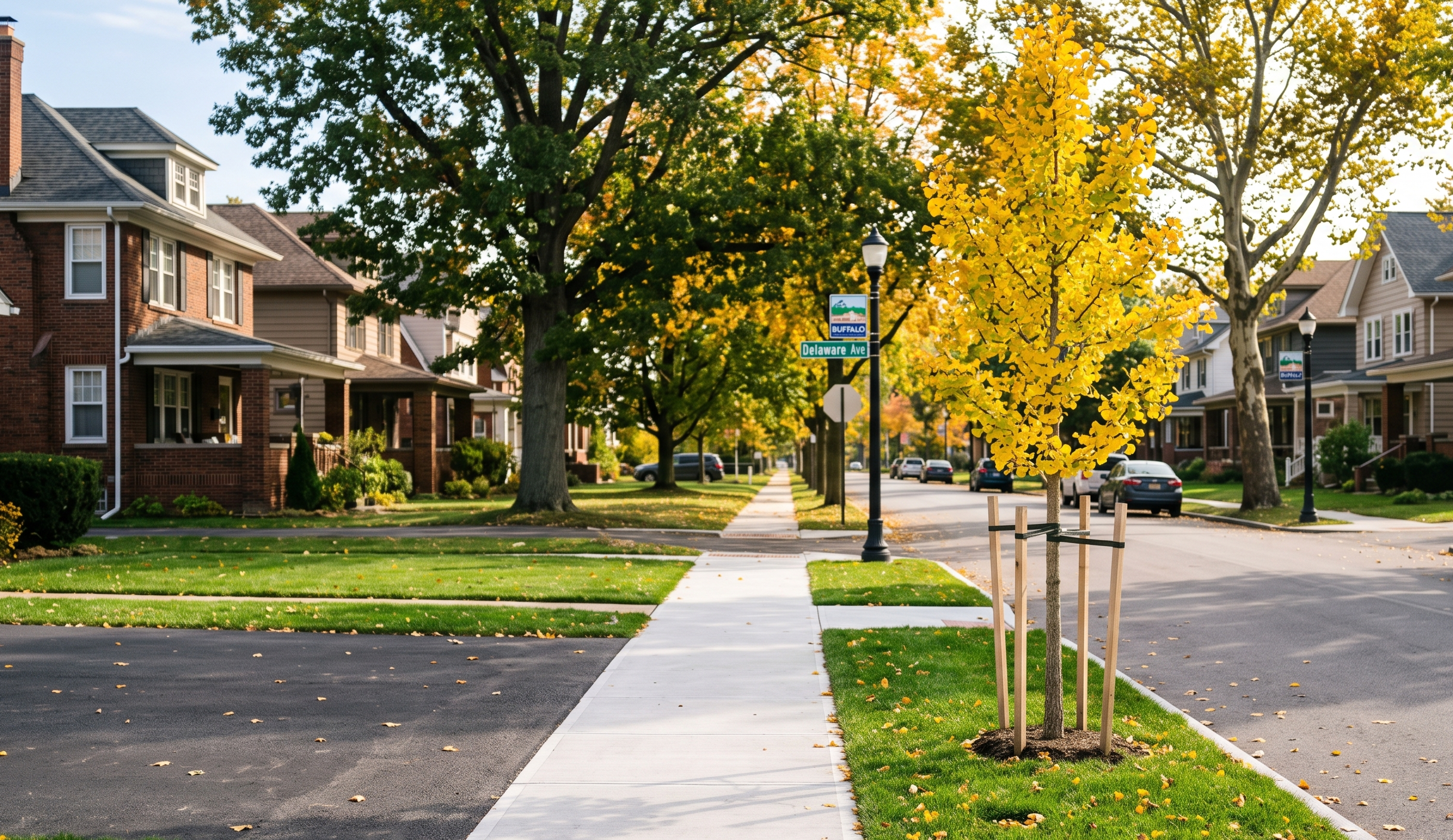
Planting a tree near a sidewalk in Western New York comes with a unique set of challenges. Between Buffalo’s heavy winter road salt, clay-dense soil, and drastic freeze-thaw cycles, tree roots often struggle for space. When shallow-rooted trees are forced into tight tree lawns or narrow sidewalk strips, they push upward to breathe, buckle the concrete, and create severe trip hazards that cost thousands in municipal code violations or property repairs.
Choosing sidewalk-friendly species with taproots or deep-branching root architecture ensures your curb appeal remains intact while keeping your driveway, walkway, and public sidewalks safe and level.
Below is an outline of how modern local search standards, Western New York horticultural data, and expert landscaping practices come together to help you choose the best sidewalk-friendly trees for your property.
Top Trees for Buffalo Sidewalks with Non-Invasive Roots
When selecting a tree for a narrow parkway or sidewalk strip, the key is working with professional tree planting services to choose species with deep, vertical root systems rather than aggressive, shallow lateral roots.
1. Japanese Lilac Tree (Syringa reticulata)
- Mature Height: 20 to 25 feet
- Root Profile: Compact, non-aggressive
- Best For: Small tree lawns (3 to 4 feet wide) and under power lines
- Why It Works in Buffalo: This compact, multi-stemmed or single-stem small tree is exceptionally cold-hardy and salt-tolerant. Because it stays under 25 feet, its root system remains small and contained, meaning zero lift risk for adjacent concrete slabs. It produces creamy white, fragrant blooms in early summer after spring frosts pass.
2. ‘Ivory Pillar’ or Fastigate Hornbeam (Carpinus betulus)
- Mature Height: 35 to 40 feet (Narrow spread: 10 to 15 feet)
- Root Profile: Deep-branching, non-surface rising
- Best For: Narrow street margins and tight property lines
- Why It Works in Buffalo: Hornbeams are known for extremely tough wood that handles Western New York windstorms and heavy lake-effect snow loads effortlessly. Their upright, columnar habit keeps branches away from passing delivery trucks, while their roots dive deep into clay soils rather than spreading out near the surface.
3. Male Ginkgo / ‘Princeton Sentry’ (Ginkgo biloba)
- Mature Height: 40 to 50 feet
- Root Profile: Deep taproot-dominant system
- Best For: Urban sidewalks with heavy foot traffic and road salt
- Why It Works in Buffalo: The Ginkgo is practically indestructible. It tolerates high soil pH, heavy urban pollution, compacted soil, and heavy winter salt runoff. Selecting a male cultivar like ‘Princeton Sentry’ guarantees no messy fruit on the sidewalk, while its vertical taproot system keeps concrete completely undisturbed.
4. Serviceberry (Amelanchier x grandiflora)
- Mature Height: 15 to 25 feet
- Root Profile: Fibrous, non-invasive roots
- Best For: Residential front yards, historic neighborhoods, and small parkways
- Why It Works in Buffalo: Native to the Northeast, Serviceberry handles cold winters with ease. Its root system is non-destructive, making it safe for walkways and stone retaining walls. It offers multi-season value: white spring flowers, edible summer berries, and brilliant red-orange autumn foliage.
5. Eastern Redbud (Cercis canadensis)
- Mature Height: 20 to 30 feet
- Root Profile: Heart-root system (descends deep before branching)
- Best For: Medium tree lawns (4 to 6 feet wide)
- Why It Works in Buffalo: Redbuds provide dramatic early-spring pink blossoms right as Buffalo comes out of winter. Because they establish deep central roots before spreading, they rarely disrupt nearby flatwork or curbs when given standard spacing.
Frequently Asked Questions
Q: Why is it important to choose a male Ginkgo tree over a female one near a sidewalk?
A: Female Ginkgo trees drop fleshy seed pods in autumn that produce a pungent odor when crushed and create slippery hazards on concrete walkways. Male cultivars, like ‘Princeton Sentry,’ are fruit-free and clean.
Q: How well do small decorative trees handle heavy Buffalo road salt?
A: Species like the Japanese lilac tree and ginkgo have high salt tolerance, making them resilient against spray from snowplows. More sensitive trees, like redbuds, perform better when planted a few feet back from the curb edge or protected by a root barrier.
What Causes Trees to Buckle Sidewalk Concrete?
To prevent concrete heave, it helps to understand why it happens in the first place:
- Compacted Clay Soils: Much of Western New York features dense clay soil. Oxygen and water struggle to penetrate deep layers, so roots grow upward toward the surface to find moisture and air.
- Poor Species Choice: Fast-growing trees like silver maples, willows, sweetgums, and American elms have aggressive, surface-level lateral roots designed to grab shallow water.
- Inadequate Growing Space: Planting a tree with a 50-foot mature canopy inside a 2-foot planting strip forces roots to press directly against concrete sub-bases.
- Soil Freeze-Thaw Cycles: Water trapped beneath paved surfaces freezes and expands during Buffalo winters, lifting concrete slightly. If your walkway has already suffered damage, exploring concrete repair and flatwork options alongside proper tree selection can save your entry path.
Frequently Asked Questions
Q: Can you shave or cut tree roots to stop them from lifting a sidewalk?
A: Severing large structural roots close to the trunk can destabilize the tree, making it vulnerable to windthrow during violent thunderstorms or winter gales. It also opens wounds for wood-rotting fungi. Installing a root barrier during initial planting is far safer than cutting roots later.
Q: Why does clay soil make sidewalk cracking worse in Western New York?
A: Dense clay holds moisture tightly and compacts easily under foot traffic and equipment. Because deep clay layers lack oxygen, roots naturally shift toward the top few inches of soil right under the permeable base layer of the concrete.
Best Practices for Planting Near Sidewalks
To guarantee your hardscaping stays intact for decades, follow these professional installation rules:
Observe Minimum Setback Distances
- Small Trees (<25 ft mature height): Plant at least 3 feet from concrete edges.
- Medium Trees (25–40 ft mature height): Plant at least 5 to 6 feet away.
- Large Canopy Trees (>40 ft mature height): Require 8+ feet of open soil margin.
Install Root Deflectors / Root Barriers
When planting within 5 feet of a walkway or driveway, install a vertical physical root barrier along the concrete edge. These 18-to-24-inch deep high-density polyethylene panels force tree roots to grow downwards into deeper soil strata before branching laterally, keeping them safely beneath the concrete’s gravel base.
Aerate and Amend the Planting Pit
Rather than digging a deep, narrow hole, dig a broad planting area 2 to 3 times wider than the root ball. Loosening compacted surrounding soil encourages roots to spread outward at a safe depth rather than turning upward toward the surface.
Frequently Asked Questions
Q: How deep should a root barrier be installed near a sidewalk?
A: Root barriers should be installed 18 to 24 inches deep along the side of the sidewalk or curb. The top edge should sit slightly above the soil line (about 1 inch) to prevent surface roots from jumping over the top of the barrier.
Q: How close to a sidewalk can I safely plant a tree if I use a root barrier?
A: With a properly installed physical root deflector, smaller species can be planted as close as 2 to 3 feet from the pavement without risking future concrete lift.
Looking for Professional Tree Planting & Landscaping Near Me in Buffalo, NY?
If you’re a homeowner or property manager searching for trusted tree planting services or hardscape-safe landscaping in Western New York, 10X Landscaping is here to help. Planting trees in tight urban spaces requires more than just digging a hole—it takes local expertise to prevent future sidewalk cracking, underground utility damage, and driveway upheaval.
Neighborhoods & Service Areas We Cover
We provide sidewalk-friendly tree planting, root barrier installation, and tree lawn restoration across the entire Greater Buffalo metro area, including the following:
- City of Buffalo: Elmwood Village, North Buffalo, Delaware District, South Buffalo, West Side, and Black Rock.
- Northern Suburbs: Amherst, Williamsville, Tonawanda, Kenmore, and Clarence.
- Southern & Eastern Suburbs: Cheektowaga, West Seneca, Orchard Park, and Hamburg.
Whether you’re updating a historic tree lawn in North Buffalo or planting new shade trees near a concrete driveway in Amherst, our team understands local municipal codes, utility markouts (Dig Safely NY / 811), and deep-root installation techniques.
Visit Our Local Location
To help Google verify our local business authority and provide clear location signals for Western New York clients, you can find our service hub embedded below:
Frequently Asked Questions
Q: How does hiring 10X Landscaping prevent future sidewalk repairs near me?
A: We combine expert species selection with professional physical root barriers (installed 18–24 inches deep). This directs root growth downward into deep soil strata rather than allowing roots to crawl laterally beneath your concrete walkway or driveway.
Q: Can 10X Landscaping handle municipal permits for planting in Buffalo tree lawns?
A: Yes. When planting in public tree lawn strips (between the curb and sidewalk), we help verify municipal guidelines, ensure compliance with local forestry departments, and coordinate utility markouts before any digging begins.
Trees to Avoid Near Buffalo Sidewalks
Steer clear of these fast-growing, surface-rooting species near paved surfaces:
- Silver Maple (Acer saccharinum): Highly invasive root systems that aggressively lift sidewalks and invade underground utility lines.
- Willow Species (Salix): Water-seeking surface roots that break pipes and buckle pavements.
- Norway Maple (Acer platanoides): Dense, shallow root mats that push up concrete and starve surrounding lawn grass.
- Pin Oak (Quercus palustris): Drooping lower branches obstruct pedestrians, and thick surface roots heave narrow walk paths.
Frequently Asked Questions
Q: What should I do if I already have a silver maple raising my sidewalk?
A: If the concrete is severely lifted, options include replacing the concrete slab with a curved offset around the root flare, replacing concrete with rubberized, permeable pavers, or consulting an ISA-certified arborist to evaluate whether the tree can be safely pruned or needs removal.
Q: Are native maples like red maple (Acer rubrum) safe near sidewalks?
A: Red maples have somewhat better root architecture than silver maples, but they still carry a medium-to-high risk of shallow surface roots in compacted clay soils. If planted, they require wider tree lawns (at least 6 to 8 feet) and deep root deflectors.
Smart Planning for Lasting Landscapes
By matching deep-rooting, salt-tolerant tree species with proper root barrier protection and adequate spacing, you can enjoy a shady, tree-lined streetscape without dealing with cracked concrete or trip hazard repairs. Careful planning today protects your investment in both your green canopy and your hardscape infrastructure for years to come.
Frequently Asked Questions
Q: When is the best time of year to plant sidewalk trees in Buffalo?
A: Early fall (September through November) is ideal for planting trees in Western New York. Cool air temperatures paired with warm soil allow roots to establish before the ground freezes, giving the tree a head start before summer heat arrives.
Q: How often should new sidewalk trees be watered in their first season?
A: New trees need about 10 to 15 gallons of water per week during their first two growing seasons. Slow-drip watering bags (like Treegators) work exceptionally well in sidewalk strips to ensure water reaches deep roots rather than running off onto the pavement.