


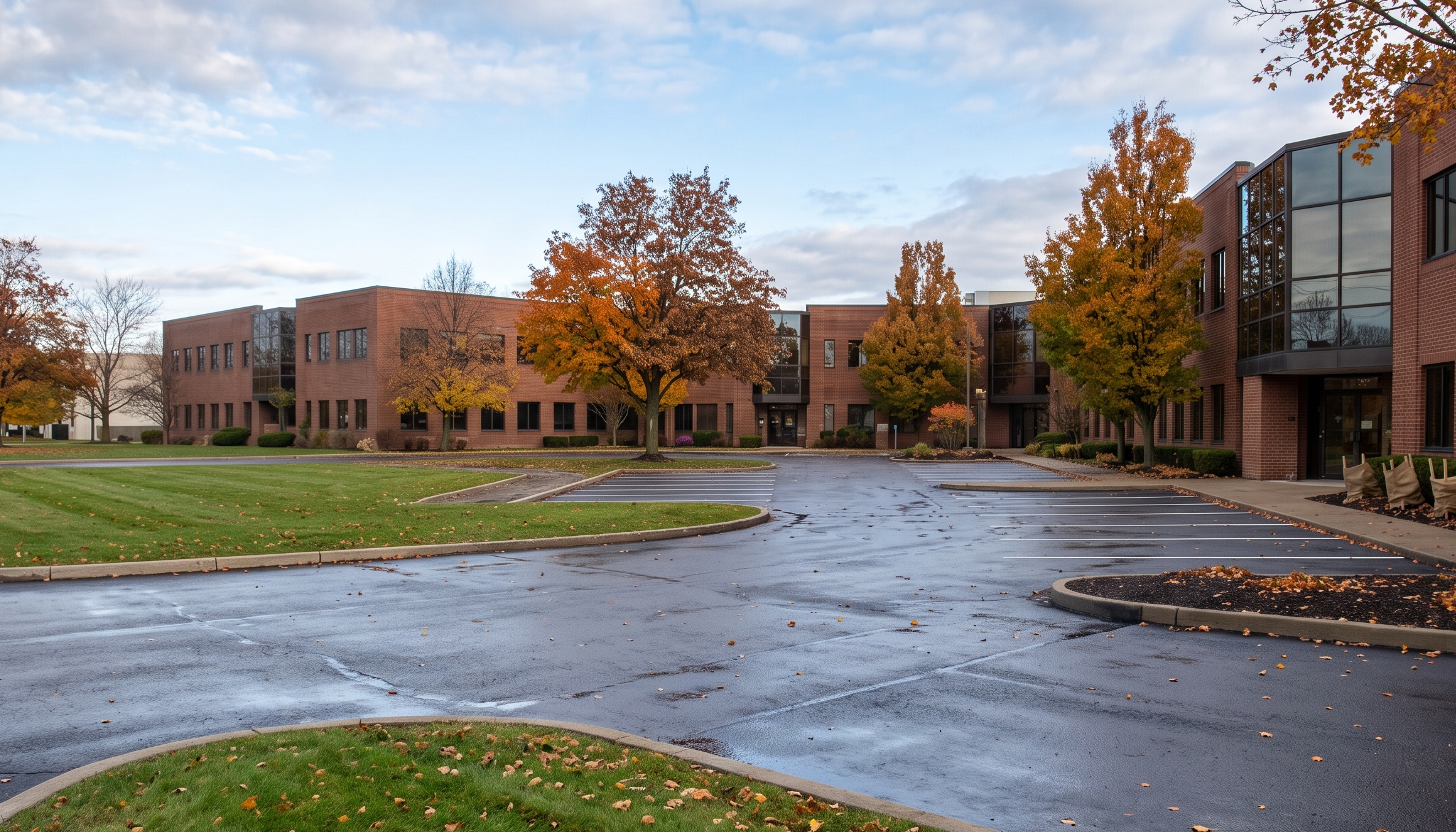
When late autumn sweeps across Western New York, facility directors, property managers, and business owners know that heavy Lake Erie squalls are right around the corner. Implementing a structured protocol for commercial site winterization is essential for Buffalo businesses looking to safeguard concrete assets, eliminate premises liability, and ensure uninterrupted daily operations. From freezing lake-effect storms to continuous freeze-thaw cycles, winter weather in the Queen City demands specialized site care far beyond basic seasonal cleanup. At 10X Landscaping, our commercial grounds teams use this field-tested, comprehensive winterization guide to keep commercial sites across Erie and Niagara counties protected and compliant all season long.
1. Commercial Irrigation Shutdown & Compressed Air Blowout
Leaving standing water in underground lateral lines when the Western New York frost line deepens is the fastest route to blown manifolds, shattered valve bodies, and cracked backflow assemblies.
- Main Water Supply Isolation: Shut and tag the main interior/exterior backflow shutoff valve.
- Regulated High-CFM Air Blowout: Connect an industrial air compressor delivering high volume ($80\text{–}100\text{ CFM}$) at controlled pressure ($50\text{–}80\text{ PSI}$) to evacuate all heads systematically until only atomized vapor discharges.
- RPZ Valve Disassembly & Protection: Drain and winterize the Reduced Pressure Zone (RPZ) backflow device. Internal test cocks must remain open at a 45-degree angle, and sensitive internal assemblies should be stored in a climate-controlled environment.
- Controller Deactivation: Power down or toggle smart commercial controllers to seasonal sleep/rain-off modes to prevent dry solenoid cycling.
Frequently Asked Questions
Q: When should Buffalo businesses schedule their commercial irrigation blowout?
A: Complete irrigation blowouts between mid-October and the first week of November, before sustained ground temperatures drop below 32°F (0°C).
Q: Can gravity drain valves replace an industrial compressor blowout?
A: No. Gravity drains fail to pull trapped water out of undulating lateral pipes, deep manifolds, and elevated spray heads across large commercial perimeters.
2. Pavement, Asphalt, and Drainage Infrastructure Preparation
Western New York’s rapid freeze-thaw cycles drive pothole formation. Sub-base moisture expands by roughly 9% upon freezing, generating massive hydraulic pressure that breaks asphalt apart under heavy delivery truck and plow traffic.
- Hot-Pour Rubberized Crack Sealing: Rout and seal all cracks exceeding $1/8\text{ inch}$ using hot-applied polymeric sealants to block meltwater and chemical brine intrusion.
- Catch Basin & Swale Cleanout: Vacuum and clear fallen leaves, gravel, and silt from storm grates, retention basins, and swales to stop parking lot ponding and sheet ice formation.
- Surface Hazard & Obstacle Mapping: Survey and document expansion joints, recessed utility covers, and transitioning curb lines before snowfall to prevent plow blade impact damage.
Frequently Asked Questions
Q: Why is pre-winter crack sealing critical for commercial parking facilities?
A: Sealing prevents runoff and brine from penetrating the sub-base, stopping the freeze-expand-collapse cycle that causes deep potholes and tripping hazards.
Q: How frequently should commercial catch basins be cleared in late fall?
A: Inspect and clear grates bi-weekly during peak defoliation and immediately after severe autumn windstorms to maintain open drainage pathways.
3. Commercial Turf Hardening and Late-Season Agronomy
Corporate turf requires targeted agronomic conditioning before entering extended winter dormancy beneath packed snowdrifts. Fall root fortification determines how quickly grass recovers from snow mold and salt exposure come spring.
- Deep-Tine Core Aeration: Relieve severe summer soil compaction on high-traffic lawns and common areas, opening channels for root oxygenation.
- High-Potassium Winterizer Application: Apply a slow-release late-season fertilizer rich in potassium ($\text{K}$) to strengthen plant cell membranes against intracellular freezing damage.
- Step-Down Mowing Height: Gradually drop cutting decks to a final height of 2 to 2.5 inches. Leaving grass too long causes blade-matted layers that foster Microdochium nivale (pink and gray snow mold).
- Mechanical Leaf Removal: Remove all turf leaf cover to prevent sunlight starvation, moisture trapping, and rodent harborage.
Frequently Asked Questions
Q: What is the specific role of late-season aeration for commercial lawns?
A: Aeration breaks up compacted soil, allowing autumn nutrients, water, and oxygen to reach the root zone before hard ground frost sets in.
Q: Why is a lower final cut height important before the first snowfall?
A: Keeping grass around 2 to 2.5 inches prevents tall turf from matting under heavy snowpack, eliminating the damp microclimate where spring snow mold thrives.
4. Tree, Shrub, and Ornamental Plant Protection
Heavy lake-effect snow loads snap branches, while sustained sub-zero winds off Lake Erie cause rapid transpirational moisture loss in broadleaf evergreens.
- Dormant Structural Pruning: Remove dead, cracked, or structurally compromised limbs near commercial walkways, entryways, and parking areas to mitigate liability from snow-weight drop.
- Evergreen Anti-Desiccant Spraying: Apply a polymer-based anti-desiccant coating to broadleaf evergreens (such as boxwoods, hollies, and rhododendrons) to lock in internal moisture.
- Staked Wind & Burlap Screening: Erect wooden support framing and secure breathable burlap barriers around high-value shrubs exposed to roadway salt spray and wind funnels.
- Root Flare Mulch Refresh: Level shredded bark mulch to a consistent 2-to-3-inch depth across planting beds, keeping mulch back from bark stems to insulate root zones without inducing rot.
Frequently Asked Questions
Q: How does anti-desiccant spray protect evergreens in Buffalo?
A: It forms a breathable, protective membrane over foliage, stopping dry winter winds from stripping moisture out of leaves when frozen roots cannot pull water from the soil.
Q: Can burlap wrap be placed directly on shrub foliage?
A: Wrapping directly against foliage is not recommended; moisture can freeze the burlap to the leaves, causing severe contact freeze burn. Always secure burlap to anchored wooden stakes.
5. Snow Staking and Site Safety Layout
Safe, rapid snow plowing starts with clear boundary delineation before blizzards conceal curbs, fire risers, and island dividers.
| Site Zone | Preparation Protocol | Operational & Safety Benefit |
| Curbs & Traffic Islands | Drive 48-inch reflective fiberglass stakes every 10–15 ft. | Prevents plow blades and heavy equipment from tearing up concrete curbs and grass borders. |
| Hydrants & Standpipes | Stake with high-visibility color-coded emergency flags. | Keeps critical municipal and life-safety fixtures visible to emergency crews during blizzards. |
| Dedicated Snow Storage | Designate downstream perimeter zones away from building paths. | Prevents melting snow piles from draining across walkways and refreezing into black ice sheets. |
| Signage & Light Bases | Stake concrete pillar bases and clear brush around signs. | Protects site lighting assets and ensures driver sightlines remain unobstructed. |
Frequently Asked Questions
Q: Why are flexible fiberglass stakes superior to wooden lath or steel rebar?
A: Fiberglass flexes on equipment impact without breaking, will not rot or rust, and includes 360-degree reflective tape for nighttime visibility during whiteout conditions.
Q: Where should commercial snow piles be positioned?
A: Store snow in lower-grade perimeter sections away from high-traffic pedestrian entrances, storm drains, and sightlines to stop daytime meltwater from refreezing across travel lanes.
6. De-Icing Material Sourcing and On-Site Storage
Standard rock salt (Sodium Chloride, $\text{NaCl}$) loses chemical effectiveness once pavement temperatures sink below $15^\circ\text{F}$ ($-9.4^\circ\text{C}$), a routine condition during Buffalo cold snaps.
- Treated Calcium & Magnesium Chloride: Stock enhanced de-icing blends formulated to melt snow and bond to pavement down to $-20^\circ\text{F}$.
- Landscape & Hardscape-Safe Melts: Deploy Calcium Magnesium Acetate (CMA) or coated blends along custom paver entries and sensitive landscape borders to eliminate salt burn and concrete pitting.
- Weatherproof Storage Bins: Position heavy-duty, sealed poly bins filled with de-icing compound and safety scoops directly at primary employee and visitor doorways for rapid spot treatment.
Frequently Asked Questions
Q: What de-icer is recommended for new concrete installations?
A: For concrete installed within the last two years, use Calcium Magnesium Acetate (CMA) or non-corrosive, salt-free melting agents to prevent chemical spalling and surface degradation.
Q: What is the standard protocol for on-site salt storage?
A: Keep de-icer in tightly sealed, waterproof storage containers near building entrances to block ambient humidity and prevent product caking.
Serving Buffalo and Surrounding Western New York Communities
If you are looking for reliable commercial site winterization and grounds management near you, 10X Landscaping operates route-managed crews across Erie and Niagara counties.
Our Western New York Commercial Service Coverage:
- Northtowns: Amherst, Williamsville, Clarence, Tonawanda, Grand Island, Wheatfield
- Buffalo Core & Waterfront: Downtown Buffalo, Elmwood Village, Larkinville, South Buffalo, First Ward
- Southtowns & Eastern Suburbs: Cheektowaga, West Seneca, Orchard Park, Hamburg, Lancaster, Depew
Whether your facility is located near the Buffalo Niagara International Airport, along the I-290 and I-90 commercial corridors, or in downtown office parks, our winterization units ensure your exterior infrastructure remains compliant, safe, and protected.
Local Headquarters & Service Hub
Summary Checklist for Buffalo Property Managers
- [ ] Irrigation: Complete high-CFM compressed air blowout and secure backflow assemblies.
- [ ] Hardscapes: Seal asphalt cracks and clear all catch basins of autumn debris.
- [ ] Turf: Aerate compacted zones, drop mower deck height, and apply potassium-rich fertilizer.
- [ ] Trees & Shrubs: Prune dangerous limbs, apply anti-desiccant, and frame burlap barriers.
- [ ] Site Safety: Drive high-visibility reflective fiberglass stakes along curbs and obstacles.
- [ ] Ice Control: Stock temperature-rated de-icing compounds in sealed on-site bins.
Protect Your Commercial Grounds with 10X Landscaping
Proactive site winterization protects your physical assets and shields your business from costly winter repair bills and premises liability. 10X Landscaping provides turn-key commercial property maintenance, site winterization, and dedicated snow and ice management for business parks, retail centers, industrial complexes, and corporate offices across Western New York.
Contact our commercial team today at (716) 303-3595 to schedule your pre-winter site assessment and lock in your commercial winter services before freezing temperatures arrive.