


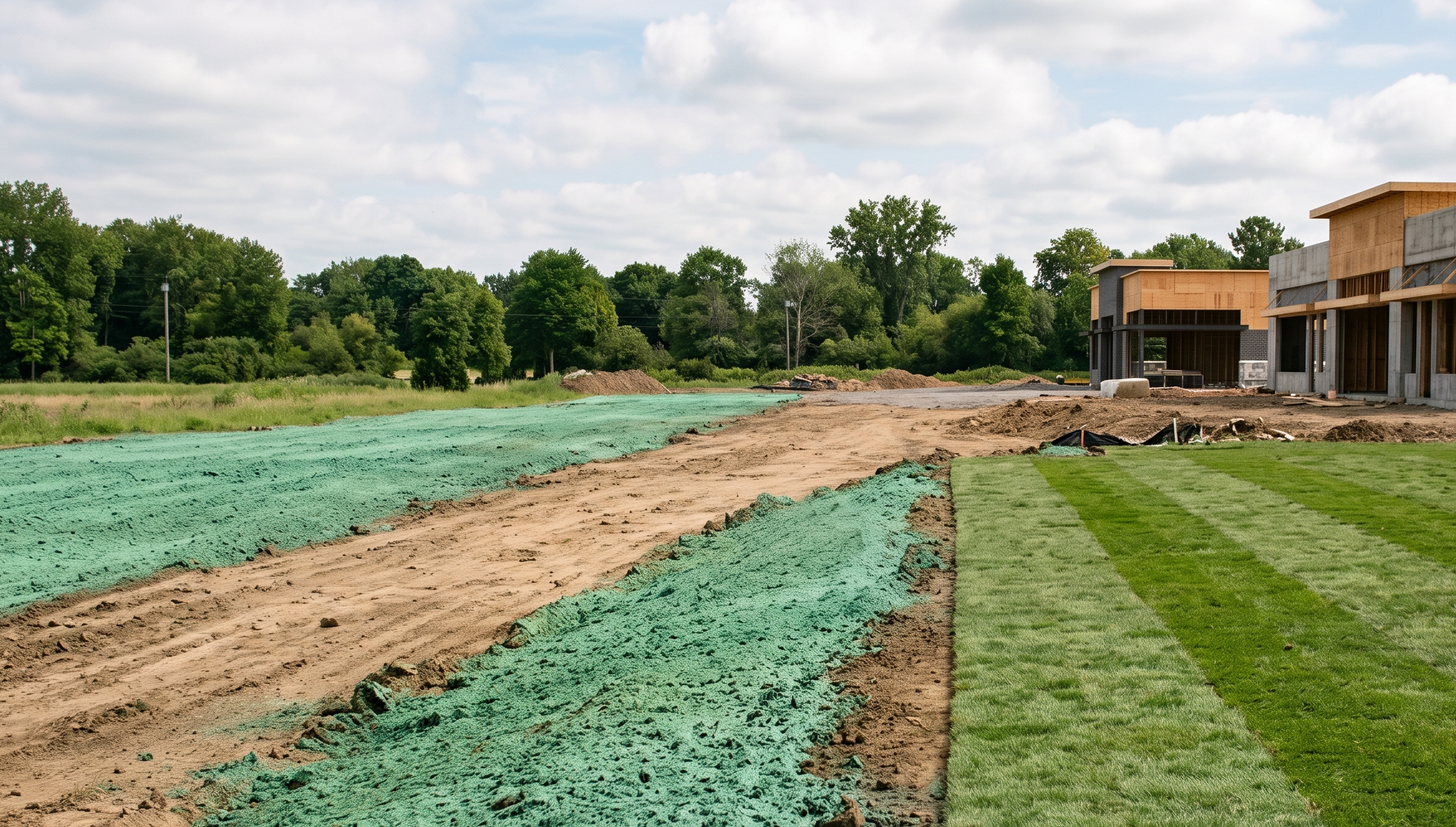
Every commercial real estate and residential subdivision project in Western New York eventually reaches the site finish phase, where ground stabilization and curb appeal make or break final delivery. For regional builders, selecting between hydroseeding vs. sod is fundamentally a financial and logistical calculation rather than just an aesthetic choice. Balancing upfront site development budgets, strict New York State Department of Environmental Conservation (NYS DEC) stormwater compliance deadlines, and the brutal reality of Erie County freeze-thaw cycles requires a granular understanding of the total cost of ownership. Whether you are managing a multi-phase subdivision in Clarence, finishing an industrial logistics hub near Cheektowaga, or revitalizing a mixed-use commercial parcel in downtown Buffalo, understanding the true cost-benefit of turf establishment directly protects your project margins.
Upfront Capital Costs: A Per-Square-Foot Breakdown
When assessing raw project line items, hydroseeding consistently provides a significantly lower initial price tag compared to sod installation. However, analyzing square footage costs in isolation fails to account for labor intensity, site prep, and irrigation demands.
| Metric / Cost Item | Commercial Hydroseeding | Commercial Sod Installation |
| Material & Application | $0.10 – $0.22 / sq. ft. | $0.85 – $1.75 / sq. ft. |
| Cost per Acre (43,560 sf) | $4,350 – $9,500 / acre | $37,000 – $76,000 / acre |
| Labor Intensity | Minimal (slurry tank application) | Heavy (manual roll lay & seam) |
| Prep & Grading Needed | Fine grade + loose topsoil | Smooth finish grade + tamped |
| Time for Green Appearance | 7 – 14 days (germination) | Instant (Day 1) |
| Time to Structural Root | 4 – 8 weeks | 2 – 4 weeks |
The Scale Multiplier
On a compact 3,000-square-foot frontage for a retail pad, the price difference between sod ($3,500–$5,200) and hydroseeding ($450–$700) might seem negligible when weighed against immediate certificate-of-occupancy (CO) requirements.
However, as acreage expands on multi-lot residential tracts or large commercial campuses (5 to 20+ acres), the spread widens dramatically. Saving $30,000 to $60,000 per acre allows developers to allocate capital toward architectural upgrades, asphalt paving, or tenant improvement allowances without sacrificing ground stabilization.
Frequently Asked Questions
Q: Why is sod installation significantly more expensive per square foot than hydroseeding?
A: Sod requires labor-intensive harvesting, climate-sensitive refrigerated transport, and manual roll-by-roll laying with seam-tamping. Hydroseeding uses mechanical tank agitation and hydraulic hose application, requiring a smaller crew and less manual labor.
Q: Are there hidden mobilization or site prep costs specific to hydroseeding?
A: Commercial hydroseeding requires accessible water tanker hookups or on-site hydrants to mix slurry batches. For very small or isolated patches under 1,500 sq. ft., mobilization minimums may reduce per-square-foot cost advantages.
The Buffalo Climate Factor: Soil, Snow, and Seasonal Windows
Landscaping specifications that succeed in the Mid-Atlantic fail quickly when applied to Western New York. Buffalo’s USDA Hardiness Zone (ranging from 6a to 6b) features heavy glaciated clay soils, persistent lake-effect precipitation, rapid seasonal transitions, and severe spring freeze-thaw cycles.
1. Heavy Native Clays and Root Anchorage
Much of Erie and Niagara County soil is dense, slow-draining clay.
- Sod Vulnerability: Traditional Kentucky Bluegrass sod cut from sandy loam farms often struggles with “soil layering.” When root systems transition from the shallow imported sod base into dense native clay, they can hover near the surface, leaving the turf susceptible to frost heave and drought stress.
- Hydroseeding Adaptability: A hydroseed slurry—combining wood fiber mulch, tackifiers, balanced starter fertilizer, and tailored seed mixes—allows roots to germinate directly into the existing, amended native substrate. Deep root penetration naturally aerates the soil and creates long-term structural drought tolerance.
2. Tailored Cool-Season Blends
Sod is generally limited to mono-stands or basic two-way blends of Kentucky Bluegrass cultivated for visual uniformity. With commercial hydroseeding, developers can customize the seed mix specifically for Buffalo microclimates:
- Turf-Type Tall Fescues (TTTF): Deep taproots that cut through hard clay and resist salt runoff from parking lot plowing.
- Perennial Ryegrass: Rapid 5-to-7-day germination to stabilize slopes and suppress early weed pressure.
- Fine Fescues: Exceptional shade and low-water tolerance for tree-lined corporate parks and northern property exposures.
Frequently Asked Questions
Q: How does Buffalo’s lake-effect freeze-thaw cycle affect newly laid sod vs. hydroseed?
A: Sod that has not rooted deeply before December can experience frost heave, lifting the rolls and killing root systems. Hydroseeded turf germinated in early fall and established deep, integrated root channels in native clay that resist frost heave.
Q: Can commercial seed blends resist road salt from winter snow clearance?
A: Yes. Hydroseed slurry blends can incorporate salt-tolerant turf-type tall fescues and alkaligrass along roadway buffers and parking medians—a custom tailoring option impossible with standard mono-stand Kentucky bluegrass sod.
Timeline vs. Holding Costs: The Schedule Math
For builders and project managers, time is capital. Carrying costs, lender interest, and delayed closings frequently dwarf minor landscaping line-item savings.
Hydroseeding Timeline:
[Day 0: Slurry Applied] -> [Day 7-10: Sprouting] -> [Day 21-28: First Mow] -> [Day 45-60: Full Root Matrix]
Sod Timeline:
[Day 0: Instant Green] -> [Day 14: Initial Root Knit] -> [Day 21: Mowing / Light Use]
When Sod Justifies the Premium
- Immediate Certificate of Occupancy (CO): If municipal inspectors in Amherst, Orchard Park, or Buffalo require 100% completed stabilization before sign-off, sod clears the barrier within 24 hours.
- Phase 1 Model Homes: Model residences require pristine curb appeal to drive pre-sales. Installing sod around the sales center while hydroseeding remaining parcels delivers the best return on investment.
- Severe Weather Windows: If exterior construction finishes in late October or early November, hydroseed germination slows significantly under falling soil temperatures. Dormant sodding or late-season sod installation can bridge the gap before the first major lake-effect snowfall.
When Hydroseeding Wins the Schedule
- Multi-Phase Developments: Subdivisions where secondary phases won’t see home construction for 6 to 18 months benefit from cost-effective stabilization that builds thick root density over time.
- Spring and Early Fall Builds: Seeding during Western New York’s prime growing windows (April 15 – June 10, or August 15 – October 1) achieves thick, mowable turf in roughly 4 to 6 weeks.
Frequently Asked Questions
Q: What is the latest date in the fall to hydroseed in Western New York?
A: The primary window closes around October 1 to ensure 30–45 days of growth before the first hard freeze. After mid-October, “dormant hydroseeding” can be done late in the season so seeds sit dormant under snow cover and germinate early in spring.
Q: How quickly can a hydroseeded commercial parcel pass municipal inspector review?
A: In optimal conditions (spring/early fall), hydroseed produces uniform ground cover in 21 to 28 days, meeting municipal requirements for vegetative stabilization once the turf reaches 70% to 80% uniform density.
Erosion Control & NYS DEC Compliance
Western New York developers must comply with strict NYS DEC State Pollutant Discharge Elimination System (SPDES) General Permits for Stormwater Discharges from Construction Activity. Failing an inspection or allowing sediment to wash into municipal storm drains triggers costly stop-work orders and fines.
- Sloped Terrain and Detention Basins: Standard sod rolls laid on slopes steeper than 3:1 require labor-heavy wooden staking and risk slipping during heavy downpours. Hydroseeding with high-performance Bonded Fiber Matrix (BFM) or Flexible Growth Medium (FGM) sprays hydraulically locks the seed and mulch directly to the soil surface. This creates an interlocking barrier capable of withstanding torrential rain events immediately after application.
- Retention Pond Banks: Hydroseeding easily coats irregular contours, swales, and rocky retention basins where laying sod sheets by hand is dangerous, inefficient, or structurally impractical.
Frequently Asked Questions
Q: Does hydroseeding qualify as temporary or permanent soil stabilization under NYS DEC SPDES permits?
A: High-performance hydroseeding formulas like Bonded Fiber Matrix (BFM) meet NYS DEC requirements for immediate temporary soil stabilization on Day 1, transitioning to permanent stabilization as root networks mature.
Q: Why does sod often fail on steep slopes or retention pond banks?
A: Sod sheets act as a barrier that water can undermine. During heavy rainstorms, water channels underneath unrooted sod layers, creating sheet erosion and washing entire rolls down the embankment into basin bottoms.
Total Cost of Ownership: Water & Maintenance Overhead
Budget comparisons must factor in post-application water consumption and maintenance during the critical establishment window.
| Requirement | Hydroseeding Protocol | Sod Protocol |
| Irrigation Frequency | 2–3 light cycles daily (moist mulch) | 1–2 deep cycles daily (soak bed) |
| Total Water Volume | Moderate (Mulch retains 10x weight) | High (must soak beneath cut pad) |
| Weed Competition Risk | Moderate (pre-emergent timing vital) | Very Low (dense mat barrier) |
| Patch Repair Cost | Low (quick overspray or hand seed) | High (cut and replace dead rolls) |
While hydroseeding requires consistent moisture during the initial 21-day germination window, its wood-cellulose mulch acts like a sponge, reducing the overall volume of water required per watering cycle compared to soaking thick sod root pads.
Frequently Asked Questions
Q: What happens if commercial irrigation is unavailable on an expansive job site?
A: Sod without automated irrigation will dry out and shrink within 48 to 72 hours, resulting in total turf loss. Hydroseeding with specialized moisture-retaining polymers can withstand short dry spells and activate when rain arrives.
Q: How are washouts or uneven patches repaired in hydroseeding vs. sod?
A: Hydroseed patches can be quickly touched up with hydraulic spot-spraying or broadcast seeding at minimal cost. Sod patches require cutting out dead squares, re-leveling the soil, and installing fresh rolls.
The Buffalo Developer’s Decision Matrix
To streamline value engineering during site planning, use this quick reference framework:
- Specify Sod When:
- Project closeout is less than 14 days away, and municipal sign-off requires immediate ground cover.
- Building high-visibility retail pads, corporate headquarters frontages, or active residential sales models.
- Landscaping narrow urban infill lots where bringing hydroseeding equipment is logistically unfeasible.
- Specify Hydroseeding When:
- Stabilizing open acreage, multi-lot subdivisions, utility easements, or industrial logistics parks.
- Grading retention ponds, engineered swales, highway embankments, or slopes exceeding a 3:1 pitch.
- Custom seed blends are necessary to withstand heavy clay soils, winter road salt, or partial shade.
- Preserving working capital and reducing per-square-foot site finish costs is a top project priority.
Frequently Asked Questions
Q: Is a hybrid turf establishment plan commonly approved in Erie County?
A: Yes. Many Western New York commercial developers specify sod along public street frontages and entrance monuments for instant curb appeal, while hydroseeding back acreage, stormwater swales, and future expansion pads.
Q: How does site soil compaction influence the choice between sod and hydroseeding?
A: Heavily compacted subsoils from heavy machinery must be decompressed with a Harley rake or disc prior to hydroseeding. If deep tillage is not possible before immediate closeout, laid sod provides a temporary cosmetic bridge, though long-term aeration will still be required.
Commercial Turf Establishment “Near Me”: Buffalo & WNY Service Areas
When commercial developers, site estimators, and civil contractors search for reliable commercial hydroseeding near me or turnkey sod installation in Western New York, turnaround speed, equipment fleet capacity, and regional agronomic knowledge are the deciding factors. 10x Landscaping operates dedicated commercial hydroseeding crews, industrial hydro-mulchers, water tankers, and laser-guided finish-grading machinery dispatched across Erie and Niagara Counties.
Primary Service Corridors & Municipalities
- Northtowns: Amherst, Clarence, Williamsville, Lancaster, Grand Island, and Niagara Falls.
- Southtowns: Orchard Park, Hamburg, East Aurora, Elma, and West Seneca.
- Industrial & Infill Corridors: Buffalo (Downtown / Waterfront redevelopment zones), Cheektowaga, Tonawanda, and Depew.
Whether you need rapid slope hydro-mulch stabilization near Clarence business parks or immediate sod rollout along Orchard Park residential subdivisions, our crews provide turnkey execution from finish grade to final sign-off.
Frequently Asked Questions
Q: How fast can 10x Landscaping mobilize commercial equipment to job sites near me in Erie County?
A: With centrally staged equipment in Western New York, our hydroseeding and sod crews typically mobilize within 48 to 72 hours of completed site grading.
Q: Do you offer site visits and soil sample testing across the Buffalo-Niagara region?
A: Yes. We conduct on-site inspections across all Erie and Niagara County municipalities to evaluate slope stability, soil pH, and compaction before submitting formal project bids.
Dispatch & Service Headquarters
Value Engineering Your Next WNY Site Plan
Effective site development in Western New York balances agronomic science, municipal compliance, and commercial project schedules. Hybrid specifications—utilizing sod along high-visibility street frontages and entrance monuments, paired with high-performance hydroseeding across retention basins, back lots, and common green spaces—consistently deliver optimal financial and aesthetic outcomes.
At 10x Landscaping, we collaborate directly with Buffalo-area general contractors, civil engineers, and commercial developers to build site-specific turf establishment plans. From NYS DEC erosion control compliance to precision hydroseeding and commercial sod installation, our team provides the equipment, agronomic expertise, and local capacity required to keep your project on schedule and on budget.
Frequently Asked Questions
Q: Can 10x Landscaping assist with engineering submittals for NYS DEC SPDES compliance?
A: Yes. We provide seed mix certifications, mulch application rate specifications, and bonded fiber matrix manufacturer submittals directly to project engineers and site superintendents.
Q: How far in advance should developers schedule commercial hydroseeding or sod work?
A: Scheduling 2 to 4 weeks prior to finishing grading ensures prime slotting during peak Western New York spring and late-summer seeding windows