


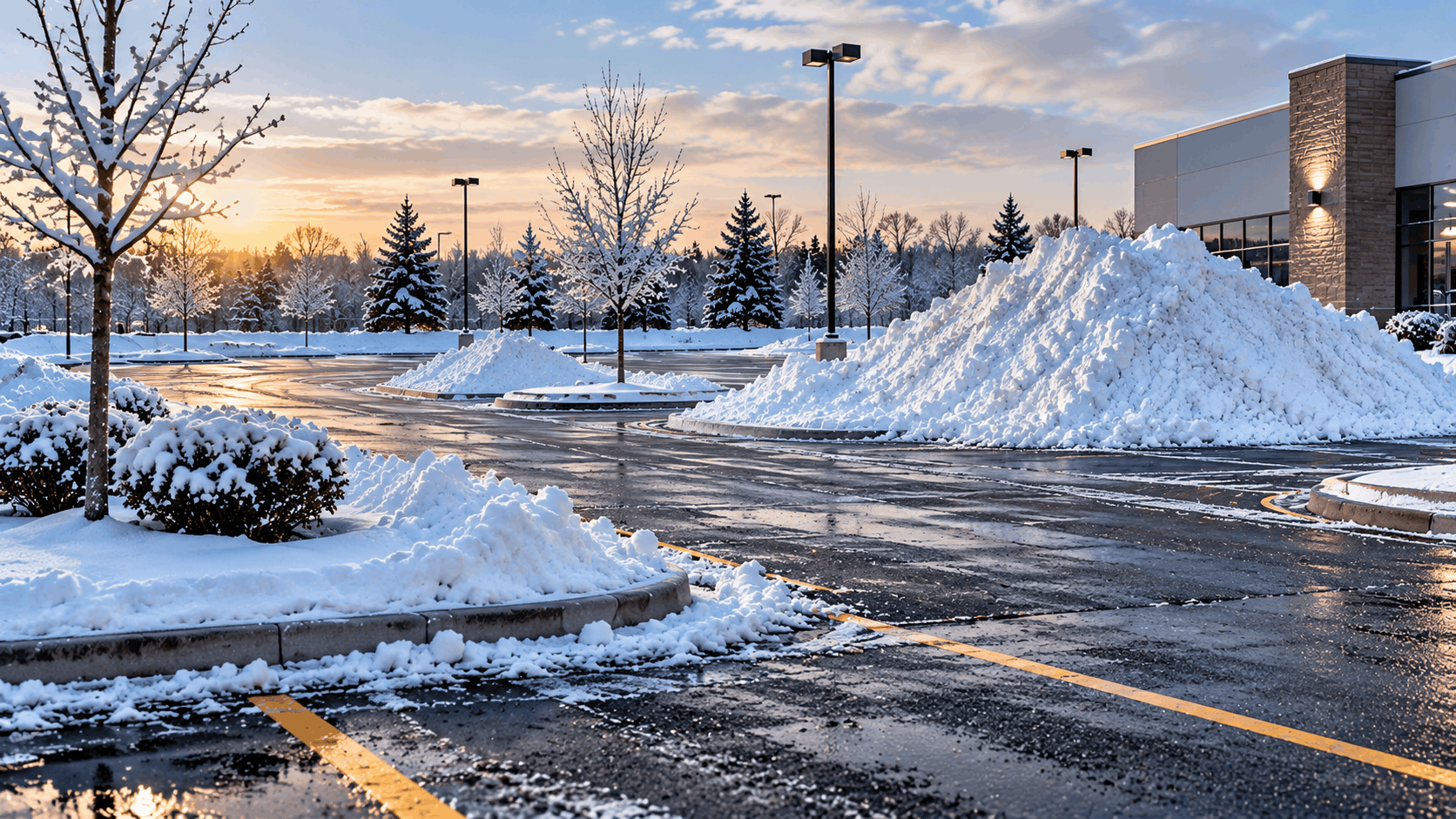
Picture a plaza in Hamburg in late February. The lot was plowed perfectly all winter, but every storm the snow went to the same convenient spot: the island right next to the main entrance, just uphill from the sidewalk. Now that pile is eight feet tall, drivers can’t see around it when they pull out, and every sunny afternoon it melts a sheet of water across the walkway that turns to ice by 5 p.m.
Nobody made one big mistake. They made the same small one forty times. At 10x Landscaping & Snow Plowing Service, we’ve been plowing commercial lots across Buffalo, Orchard Park, and Erie County for more than five years, and we’ve learned this the practical way: where you put the snow matters almost as much as how fast you move it.
Here’s how to choose good snow storage areas in a parking lot, and the spots to avoid no matter how tempting they look at 3 a.m.
Why Snow Pile Placement Matters More in Buffalo
In a city that gets a few storms a year, a bad pile melts in a week. Buffalo averages roughly 95 inches of snow a season, according to National Weather Service Buffalo climate records, and the Southtowns often see more. Cold stretches mean piles don’t shrink much between storms. They just get bigger.
That creates three problems that build all winter:
- Lost parking: every stall under a pile is a stall your tenants and customers can’t use until spring.
- Refreeze: piles melt a little on sunny days and the water refreezes at night. Where that water runs decides where your ice problem is.
- Visibility and access: piles creep into drive aisles, sight lines, and doorways one storm at a time.
A good snow storage plan solves all three before they start.
The Best Places to Pile Snow in a Parking Lot
There’s no single perfect spot on every property, but good snow storage areas tend to share the same traits.
| Good storage spot | Why it works | Watch out for |
|---|---|---|
| Far corners and the back edge of the lot | Low traffic, out of the way, rarely needed for parking. | Fences, property lines, and neighbors downhill. |
| Overflow or seldom-used stalls | Easy to push into; the lost stalls hurt least. | Count them as gone for the season and plan around it. |
| Edges that drain toward a catch basin | Meltwater goes where it should instead of across the lot. | Pile next to the drain, never on top of it. |
| Wide grassy areas away from beds and trees | Room to grow, and melt soaks into the ground. | Salt and debris left behind in spring; avoid shrubs and planted beds. |
| Sunny edges with a clear melt path | Piles shrink faster between storms. | Only if the melt runs away from walks and drive lanes. |
Think about where the water will go
This is the part people skip. Before you pick a spot, look at how the lot is graded. Water runs downhill, and a pile is just a slow-release water tank. The ideal snow storage area sits downhill of walkways and uphill of a working drain, so the melt takes a short, harmless path off the pavement.
What is the best place to pile snow in a parking lot?
A low-traffic corner or overflow stalls where meltwater can drain toward a catch basin without crossing sidewalks or drive lanes. The right spot depends on your lot’s grade, so check how water flows before winter.
Is it OK to pile snow on grass?
Often yes, as long as it’s away from planted beds, shrubs, and young trees. Expect some salt and sand to clean up in spring, and keep piles off irrigation heads and turf edges you care about.
Where You Absolutely Shouldn’t Pile Snow
These are the spots we mark as no-push zones on every commercial site map. Some are about safety, some about the law, and some just about not paying to fix something in April.
-
On or next to catch basins
A blocked catch basin is one of the most common winter problems we see. When snow buries the drain, meltwater has nowhere to go. It ponds, then freezes into a sheet of ice right where cars and people move. In a thaw, it can flood a low corner of the lot. Keep drains and the area right around them clear all season, and mark them with tall stakes before the first storm.
-
In driver sight lines
Piles at entrances, exits, and the corners of drive aisles block drivers’ view of pedestrians and oncoming traffic. Keep piles low or move them back from anywhere a driver needs to see before pulling out. If a pile near a driveway is taller than a car, it’s in the wrong place.
-
In accessible parking spaces and curb ramps
This isn’t just good practice. New York Vehicle and Traffic Law §1203-e prohibits piling snow in accessible parking spaces. Keep the spaces, access aisles, and curb ramps clear, and make sure plow drivers know exactly where they are under the snow.
-
Against doors, fire lanes, hydrants, and building equipment
Never pile snow against exit doors, in fire lanes, or around fire hydrants and fire department connections. Fire codes generally require a clear space around hydrants. Also keep piles off gas meters, electrical boxes, HVAC units, and dumpster enclosures that trucks need to reach.
-
Uphill of sidewalks and entrances
This is the Hamburg plaza mistake. A pile uphill of a walkway sends meltwater across it every sunny afternoon, and it refreezes as black ice by evening. Even a perfectly salted sidewalk can’t keep up with a pile feeding it water.
-
On landscape beds, shrubs, and trees
Plows can snap branches and crush shrubs, and salty snow sitting on a bed all winter can damage roots and soil. Because we do landscaping too, we see that damage up close every spring. Keep piles off planted beds and away from the base of trees.
-
In streams, ditches, wetlands, or the street
Snow from parking lots carries salt, oil, sand, and litter. Don’t push it into streams, drainage ditches, or wetlands. Neighboring states publish clear guidance on this, such as the Massachusetts snow disposal guidance. Pushing lot snow into a public street is also generally not allowed under local rules, so check with your town or village.
What happens if snow blocks a catch basin?
Meltwater can’t drain, so it ponds and refreezes into ice, and low areas can flood during a thaw. Keeping drains clear and staked is one of the simplest ways to reduce slip hazards on a lot.
Can we push parking lot snow into the street?
Generally no. Most municipalities don’t allow private lot snow to be pushed into public roads. Check your local rules, and plan on-site storage or hauling instead.
Not sure where your snow should go?
10x Landscaping & Snow Plowing Service will walk your lot before winter, check drainage, and mark storage areas and no-push zones so every driver knows the plan.
Planning for When the Piles Run Out of Room
In a heavy Buffalo winter, even well-planned storage fills up. The properties that handle it best decide the order of operations before December, not during a January storm.
| Stage | What happens |
|---|---|
| 1. Primary storage | Snow goes to the main storage areas marked on the site map. |
| 2. Push back the piles | After storms, piles are pushed back and stacked higher where it’s safe, to reopen space at the edges. |
| 3. Secondary storage | Pre-agreed backup spots, such as a second row of overflow stalls, come into use. |
| 4. On-site relocation | Snow is moved with a loader to a less valuable part of the property. |
| 5. Hauling | Snow is loaded and trucked off site. This is the costliest step, so agree in advance on who approves it. |
Write down who can approve each step. Nobody wants to be on the phone at 2 a.m. arguing about whether a loader is in the budget.
Keeping Snow Piles Safe All Season
- Keep piles low near drive aisles and entrances so drivers can see over them.
- Stake the edges of piles and nearby curbs so plows don’t clip them in the next storm.
- Watch the melt path and treat it with ice melt when it crosses anything people walk on.
- Keep piles away from play areas at apartment complexes and schools. Kids love to climb them, and they can collapse.
- Push piles back after every big storm instead of waiting until they block a lane.
How high can snow piles be in a parking lot?
There’s no single rule. Away from traffic, piles can be stacked high if they’re stable. Near entrances, exits, and drive aisles, keep them low enough that drivers can clearly see over them.
Put It on Your Site Map
Snow storage is one piece of a bigger winter plan. Mark your primary and backup storage areas, no-push zones, drains, and accessible spaces on a site map so every driver works from the same page. Our guide to building a snow and ice management plan walks through the whole process, from the pre-season site walk to the post-season review.
What Happens in Spring
When the piles finally melt in March or April, they leave behind sand, salt, gravel, litter, and sometimes chewed-up turf and curbs. A good plan includes a spring walk to clean storage areas, repair plow damage, and reseed grass that took a beating.
This is where working with a company that does both snow and landscaping helps. 10x Landscaping & Snow Plowing Service can fold spring cleanup and turf repair into the same relationship, so the person who knows where the piles were is the one fixing what they left behind. See our full range of services on our snow removal page.
Get your lot ready before the first storm.
10x Landscaping & Snow Plowing Service plows and salts commercial lots, plazas, offices, and multifamily properties across Buffalo, Orchard Park, and Erie County.
- Commercial lot plowing
- Salting & de-icing
- Storage marking & site maps
or email sales@10xlandscaping.com
Why Local Property Managers Call 10x
10x Landscaping & Snow Plowing Service serves commercial properties in Buffalo, Orchard Park, Hamburg, West Seneca, Cheektowaga, Amherst, and nearby towns. We plow these lots every winter, so we know how fast a Southtowns lot fills up, which corners flood in a thaw, and how to keep a plaza open through a lake-effect week.
If you’re comparing contractors, look us up on Google Maps and read what other local businesses say. And if we already plow your property, a quick Google review helps other managers in Western New York make the same decision.
The Bottom Line
Good snow storage comes down to a few simple rules: pile snow in low-traffic spots where the melt drains away safely, keep drains, sight lines, accessible spaces, doors, and hydrants clear, and decide in advance what happens when you run out of room. Do that, and the snow you push in December won’t become the ice problem you fight in March.
Let the Buffalo snow pros handle your lot this winter.
From a single office lot to a multi-site portfolio, 10x Landscaping & Snow Plowing Service keeps commercial properties, parking lots and private roads clear across Buffalo, Orchard Park and Erie County. A local crew with 5+ years of lake-effect experience.