


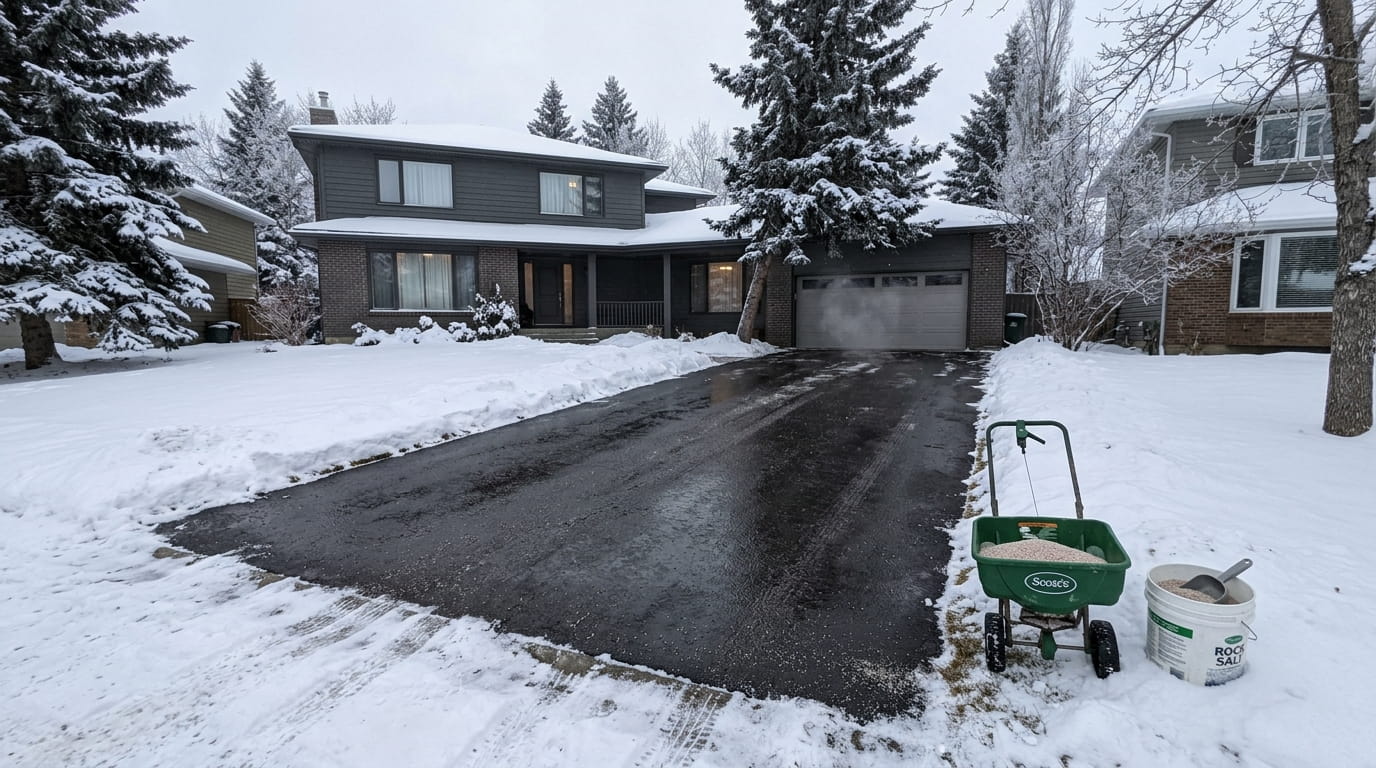
If you live in Buffalo, you already know the spot. It’s the bottom third of the driveway, right where it meets the sidewalk, or that stretch along the garage where the gutter drips. Yesterday afternoon it was just wet. This morning it’s a smooth grey sheet, and you find out the hard way when your heel goes out from under you on the way to the car.
At 10x Landscaping & Snow Plowing Service, we spend every winter clearing driveways and lots across Buffalo, Orchard Park and the surrounding Erie County towns. And the honest truth from the crew is this: most driveway ice isn’t caused by the storm. It’s caused by what happens in the 12 to 36 hours after the storm: melting, draining, and refreezing. Get ahead of that cycle and you stop the sheet before it ever forms.
This guide covers how to prevent ice on a driveway the way we think about it on the job: where the ice actually comes from, how to pre-treat, which ice melt is kindest to concrete, how to stop the overnight refreeze, and when sand beats salt. If you want the bigger picture on clearing snow itself, start with our complete guide to removing snow from a driveway.
Why Buffalo Driveways Ice Up (It’s Not Just the Snow)
Western New York winters bounce around the freezing mark constantly. A lake-effect band drops snow, it hits 34°F by early afternoon, and it’s back in the low 20s by dinner. Every swing turns snow into water and water back into ice.
When a driveway keeps icing in the same spot, it almost always traces back to one of these sources:
- Compacted snow. Snow that gets driven or walked on before it’s cleared packs into a dense layer that bonds to the pavement. It’s the single most common cause of a “permanent” icy driveway.
- Snowbank meltwater. Piles pushed to the top or uphill side of a driveway melt in the afternoon sun and run straight across the surface.
- Downspouts and roof drip. A downspout that empties onto the driveway can lay down a fresh coat of ice every single night of a thaw.
- Shade and low spots. North-facing driveways, areas shaded by the house, and dips where water pools stay colder and freeze first.
What black ice on a driveway really is
“Black ice” isn’t a special kind of ice. It’s a thin, clear glaze that lets the dark pavement show through, so it looks wet instead of frozen. On driveways, it usually forms when meltwater or light drizzle refreezes after the sun goes down. It’s the most dangerous kind precisely because you can’t see it. The National Weather Service’s black ice guidance describes the same pattern: snowmelt refreezing overnight once temperatures drop.
Why does the bottom of my driveway always ice first?
Water runs downhill. Everything that melts higher up (snowbanks, the roof, the packed snow in the tire tracks) drains to the lowest point, and that’s usually the apron by the street. The city plow ridge there adds even more meltwater, so keep that zone clear.
Step 1: Get the Snow Off Before It Turns Into Ice
It’s the step people skip. Ice melt is meant to break the bond between a thin layer of ice and the pavement, not to melt through six inches of snow. Every inch you clear is an inch you don’t need chemicals for.
What actually makes a difference:
- Clear before you drive on it. Once tires compact the snow, you’ve got a bonded layer. If you have to leave early, clear at least the tire paths first.
- Clear down to the pavement, not just “most of it.” A thin leftover film melts in the sun and refreezes overnight, exactly the sheet you’re trying to avoid.
- Don’t wait for the storm to end on a big lake-effect event. Clearing in stages keeps each layer light and prevents a heavy, compacted base from forming.
- Pile snow on the downhill side. Put banks where their meltwater drains away from the driveway, onto the lawn or the low side, rather than across it.
Should I wait until it stops snowing to clear?
For a light dusting, you can. For anything over a few inches, or any day you’ll be driving on it, clear in rounds. Lake-effect bands can dump for many hours, and the bottom layer gets packed down by the weight above it. That packed layer is what turns into ice.
Tired of chipping ice at 6 AM?
10x Landscaping & Snow Plowing Service clears residential driveways across Buffalo, Orchard Park and nearby Erie County towns, so the snow is gone before it has a chance to pack down.
Step 2: Pre-Treat Your Driveway Before the Storm
Pre-treating a driveway (the pros call it anti-icing) means putting down a small amount of de-icer before the snow falls. It doesn’t melt the storm. It stops the first layer of snow from bonding to the pavement, so everything shovels or plows off cleanly afterward.
There are two ways homeowners usually do it:
- Liquid brine. A salt-and-water solution sprayed on with a pump sprayer. The commonly used mix is roughly 23% salt by weight, about 2.5 lbs of rock salt dissolved in a gallon of water. Spray in thin stripes; once it dries you’ll see faint white lines. That residue is doing the work.
- A light dry scatter. A thin, even spread of granular ice melt shortly before the snow starts.
When pre-treating doesn’t work
Anti-icing isn’t magic, and we’d rather you know its limits up front:
- If the storm starts as rain, it washes the treatment away before the snow arrives.
- If the pavement is very cold (below roughly 15°F), plain salt brine doesn’t have much to work with.
- If it’s already snowing, you’ve missed the window. Switch to clearing first, then treating.
Check the NWS Buffalo forecast the evening before. What you want to know is how the storm starts (rain, mix, or snow) and how cold it’ll be overnight.
How far ahead of a storm should I pre-treat?
Generally a few hours up to a day ahead, as long as no rain is expected first. Brine needs time to dry on the surface so it isn’t tracked off. If you treat too far in advance and traffic wears it off, a quick touch-up the evening before is fine.
Step 3: Choose the Safest Ice Melt for Concrete (and Asphalt)
Every hardware store aisle in December has bags promising they’re “safe” or “concrete safe.” Here’s the plain-English breakdown. Working temperatures are rough real-world guides; sun, traffic and pavement temperature all change how fast a product works.
| Product | Works down to (roughly) | Concrete notes | Other trade-offs |
|---|---|---|---|
| Rock salt (sodium chloride) | ~15°F pavement | Adds to freeze–thaw scaling, especially on young or poorly finished concrete | Cheapest; hard on lawns, plants and metal |
| Calcium chloride | Well below zero | Research links it to chemical damage in concrete when over-applied | Works fast in deep cold; can burn plants |
| Magnesium chloride | Below zero | Often marketed as gentler; lab research doesn’t support that | Pricier than salt |
| Calcium magnesium acetate (CMA) | Upper teens to ~20°F | Evidence is mixed; some industry guidance flags it too | Less corrosive to metal; expensive and slow |
| Potassium chloride | Mid-20s°F | Concrete industry guidance flags it as a potential problem | Weak performer in a Buffalo cold snap |
| Ammonium nitrate / ammonium sulfate | — | AVOID: chemically attacks concrete | Common fertilizer ingredients; never spread fertilizer as ice melt |
| Sand / grit | Any temperature | No chemical effect on concrete | Traction only; does not melt ice |
So what’s actually the safest ice melt for concrete?
The honest answer: no ice melt is completely safe for concrete, including the ones that say so on the bag. Much of the damage you see (flaking, pitting, a rough surface) is freeze–thaw scaling, and any de-icer that keeps water liquid on the surface can feed that cycle. On top of that, research from Purdue University’s Joint Transportation Research Program documents that some chloride de-icers can react with the concrete itself and form an expansive compound (calcium oxychloride) that damages it, especially at joints. Calcium chloride and magnesium chloride are the main culprits named in that body of research.
What that means in practice for your driveway:
- Keep new concrete deicer-free its first year. The National Ready Mixed Concrete Association advises no de-icing salts in the first year after placement. Use clean sand for traction instead.
- Never use ammonium nitrate or ammonium sulfate. The same NRMCA guidance calls them chemically aggressive to concrete, and they’re common fertilizer ingredients, so never spread fertilizer as ice melt.
- Use the least product that does the job. Dose matters more than brand. Over-application is where most damage comes from.
- Seal older concrete. A penetrating sealer applied in fall reduces how much water and brine soak into the surface.
- Don’t pay extra for a “concrete safe” label. On good-quality, properly cured concrete, concrete-industry guidance treats plain rock salt as acceptable when used sparingly. Technique matters more than the bag.
Asphalt is more forgiving chemically. Salt is far less of a concern for the asphalt itself; the bigger risk is water getting into existing cracks and freezing. Sealing those cracks before winter protects the surface far more than switching ice melt brands.
How much ice melt should you use?
Far less than most people put down. Environmental agencies across the snow belt, including the Minnesota Pollution Control Agency, use the same rule of thumb: about 12 ounces, roughly a coffee mug, treats a 20-foot driveway or 10 sidewalk squares. Scatter it so there’s space between the grains. If you still see salt sitting on dry pavement after the ice is gone, you used too much. Sweep it up and reuse it next storm. The Wisconsin Salt Wise “Shovel, Scatter, Switch” guide is a great one-page reference to keep by the garage door.
Is “pet safe” ice melt actually safe?
Labels like “pet friendly” or “environmentally friendly” aren’t backed by a standard test, and state agencies such as the MPCA warn buyers not to rely on them. Whatever you use, use less of it, wipe your dog’s paws after walks, and keep the bag sealed and out of reach.
Step 4: Stop the Overnight Refreeze
This is where most Buffalo driveways lose the battle: the afternoon sun melts the leftovers and by 10 PM it’s glazed. Stopping refreeze overnight means getting the water off before the temperature drops.
- Clear the edges, not just the middle. Snow banked tight against the driveway edge melts and drains back across it. Push banks back a foot or two so meltwater runs into the lawn instead.
- Squeegee or push standing water off in the late afternoon. A cheap floor squeegee or a flat shovel moves slush and puddles off the surface before sundown. Water that isn’t there can’t freeze.
- Open a drainage path. If the city plow ridge at the end of the driveway is damming meltwater, cut a channel through it so water can reach the gutter.
- Re-treat right before dark, not in the morning. A light scatter of ice melt on the known wet spots around 4 PM does more than a heavy dose at 7 AM once the sheet has already formed.
Downspouts and drainage: the fix most people overlook
If you only do one thing on this list, check where your downspouts discharge. A downspout that empties onto a driveway or walkway feeds meltwater from the entire roof onto the pavement every afternoon of a thaw. Adding a downspout extension, a flexible drain pipe, or rerouting it toward the lawn is a cheap fix that often ends a “mystery” ice patch for good.
The same goes for low spots. If the same area pools every spring, it’s going to freeze every winter. That’s worth addressing with regrading or a drainage fix during the warmer months.
Why does my driveway ice over even when it didn’t snow?
Almost always meltwater. Snowbanks, roof runoff and gutters keep supplying water on sunny days, and it refreezes once the sun drops. Trace where the water is coming from; the ice patch is usually right below the source.
Let us handle the salting and de-icing too.
Salting and de-icing are part of our snow services at 10x Landscaping & Snow Plowing Service. Ask us how we can cover your property for the season.
Sand vs Salt on a Driveway: When to Use Which
People ask us this constantly, and the answer depends on the temperature and the surface.
- Use salt (or another ice melt) when you need the ice gone and pavement temperatures are above roughly 15°F. It works, but only if you clear the snow first.
- Use sand or grit when it’s too cold for salt to work, during those deep January cold snaps, or on concrete that’s less than a year old. Sand doesn’t melt anything; it just gives your boots and tires something to grip.
- Combine them sparingly on a steep driveway: a light salt treatment to break the bond, plus sand in the traction zones.
Sand has downsides too: it tracks indoors, clogs storm drains and needs sweeping up in spring. Coarse grit tracks less than fine play sand.
Long-Term Fixes That Stop Ice Year After Year
If your driveway ices up the same way every winter, a few one-time fixes can do more than any product:
- Seal before winter. Penetrating sealer on concrete, crack sealing and sealcoating on asphalt. Fall is the window; most sealers need mild, dry weather to apply properly.
- Fix drainage and grading. Low spots and poorly directed downspouts are the root cause of most recurring ice patches.
- Consider a heated driveway on a rebuild. It’s a big investment, but worth pricing out if a steep driveway is being replaced anyway.
- Protect the surface from plow and shovel damage. Gouges and chips hold water and freeze first. Our guide on whether snow plowing damages a driveway covers how to protect the surface.
How 10x Landscaping & Snow Plowing Service Approaches Driveway Ice
We’re a local crew with more than five years of Western New York winters behind us: lake-effect bands, midwinter thaws and the flash-freezes that follow. The priorities in this guide are the ones we’d give any neighbor: clear it before it packs, get the water moving off the pavement, then treat only what needs treating.
Our snow services cover residential driveways, commercial lots, private roads and multi-property accounts, along with salting and de-icing. We work across Buffalo and Orchard Park and the surrounding Erie County communities. If you’re weighing whether to handle it yourself or hire a crew this season, our snow plowing service page breaks down how we run routes and what’s included.
Driveway Ice Prevention: Frequently Asked Questions
What is the best way to prevent ice on a driveway?
Clear snow down to the pavement before it gets driven on, pre-treat before storms when temperatures allow, and keep meltwater draining off the surface. Those three habits prevent most driveway ice before any product is needed.
Will ice melt damage my new concrete driveway?
It can. Most concrete professionals recommend avoiding all chemical de-icers during a slab’s first winter. Use sand or grit for traction and clear snow promptly instead.
How do I get rid of ice that has already formed?
Break up what you can with an ice chopper or flat scraper (carefully, so you don’t gouge the surface), then apply a light scatter of ice melt to loosen the bond and clear it once it softens. If it’s too cold for salt, sand the surface for traction until temperatures rise.
Ready for a safer driveway this winter?
Call 10x Landscaping & Snow Plowing Service for driveway snow removal, salting and de-icing in Buffalo, Orchard Park and nearby Erie County towns.