


For homeowners across Western New York, the arrival of spring is bittersweet. While we welcome the warmer temperatures and the sight of green grass after months of grey skies, the transition period brings a unique, high-stakes structural challenge: heavy snowmelt.
Buffalo winters are legendary, routinely dumping feet of heavy, dense lake-effect snow across Erie County. When a sudden warm front hits—often accompanied by driving spring rains—all that frozen water liquefies simultaneously. If your property isn’t equipped with proper drainage infrastructure, thousands of gallons of runoff will head straight for your foundation.
At 10x Landscaping, we specialise in implementing advanced Buffalo drainage solutions engineered specifically for the volatile Western New York climate. Managing heavy snow melt requires more than just digging a backyard ditch; it demands a strategic, hydro-engineered approach to protect your landscape, prevent basement flooding, and safeguard your property’s structural integrity.
Frequently Asked Questions
Why is spring snowmelt worse for my home’s foundation than heavy summer rain?
Summer rain falls on warm, absorbent topsoil that acts like a natural sponge. In contrast, spring snowmelt happens when the ground underneath is still completely frozen solid. Because the soil is effectively solid ice, it cannot absorb water, forcing thousands of gallons of liquid snow to flood across the surface grading plane directly toward your foundation walls.
How do I know if my current property drainage footprint is failing during a thaw?
Look for warning signs like standing surface water pools that last more than 24 hours, mud tracks or severe soil displacement near your foundation, water weeping through basement concrete block seams, and a primary sump pump that cycles continuously every 30 to 60 seconds without a break.
The Physics of Buffalo Snow Melt: Why Standard Drainage Fails
To understand why custom drainage solutions are necessary, we must look at the science behind a Western New York thaw. Buffalo snow isn’t just fluffy powder; lake-effect snow is notoriously dense and moisture-rich.
One cubic foot of compacted snow can contain anywhere from 1 to 3 gallons of actual water. When you multiply that across an average residential lot with a 2,000-square-foot roof and a multi-car driveway, a rapid thaw can unleash 10,000 to 30,000 gallons of water onto your property within a 48-hour window.
Standard residential grading is rarely equipped to handle this volume for three critical reasons:
- The Frozen Ground Barrier: During early spring thaws, the top layers of snow melt while the soil underneath remains frozen solid (the frost line in Buffalo often extends 36 to 48 inches deep). Because the frozen earth acts like concrete, the meltwater cannot infiltrate the ground. It becomes immediate surface runoff.
- Ice Dams and Blocked Swales: Naturally occurring drainage pathways, neighborhood ditches, and municipal swales are often still choked with ice and ploughed snow, causing water to back up onto private yards.
- Hydrostatic Pressure: As water pools against your home’s foundation, it creates immense hydrostatic pressure. Water will find even the microscopic pores in poured concrete or concrete blocks, leading to damp basements, bowed walls, and catastrophic flooding.
Frequently Asked Questions
What exactly is hydrostatic pressure, and how does it damage my basement?
Hydrostatic pressure is the force exerted by standing, saturated water against a structure. When snow melts and accumulates directly against your basement walls, gravity pushes down on that trapped water, forcing it laterally through any microscopic cracks, porous concrete blocks, or shifting mortar joints. Over time, this pressure can cause basement walls to bow, crack, or structurally fail.
Can deep winter frost lines crack or collapse underground drainage pipes?
Yes, if the wrong materials or improper depths are used. Cheap, thin corrugated piping easily crushes or cracks under the weight of freezing, shifting soil layers. That is why professional installations rely on heavy-gauge, rigid smooth-wall PVC piping buried below local frost thresholds or designed with precise pitch to drain completely, preventing standing water from freezing inside the line.
Advanced Buffalo Drainage Solutions for High-Volume Runoff
Successfully managing heavy snow melt requires routing water away from vulnerable zones using a combination of subsurface drainage, surface grading, and strategic collection points.
1. High-Capacity French Drain Systems
A traditional French drain is excellent for minor yard dampness, but managing Buffalo’s rapid thaws requires a heavy-duty variation.
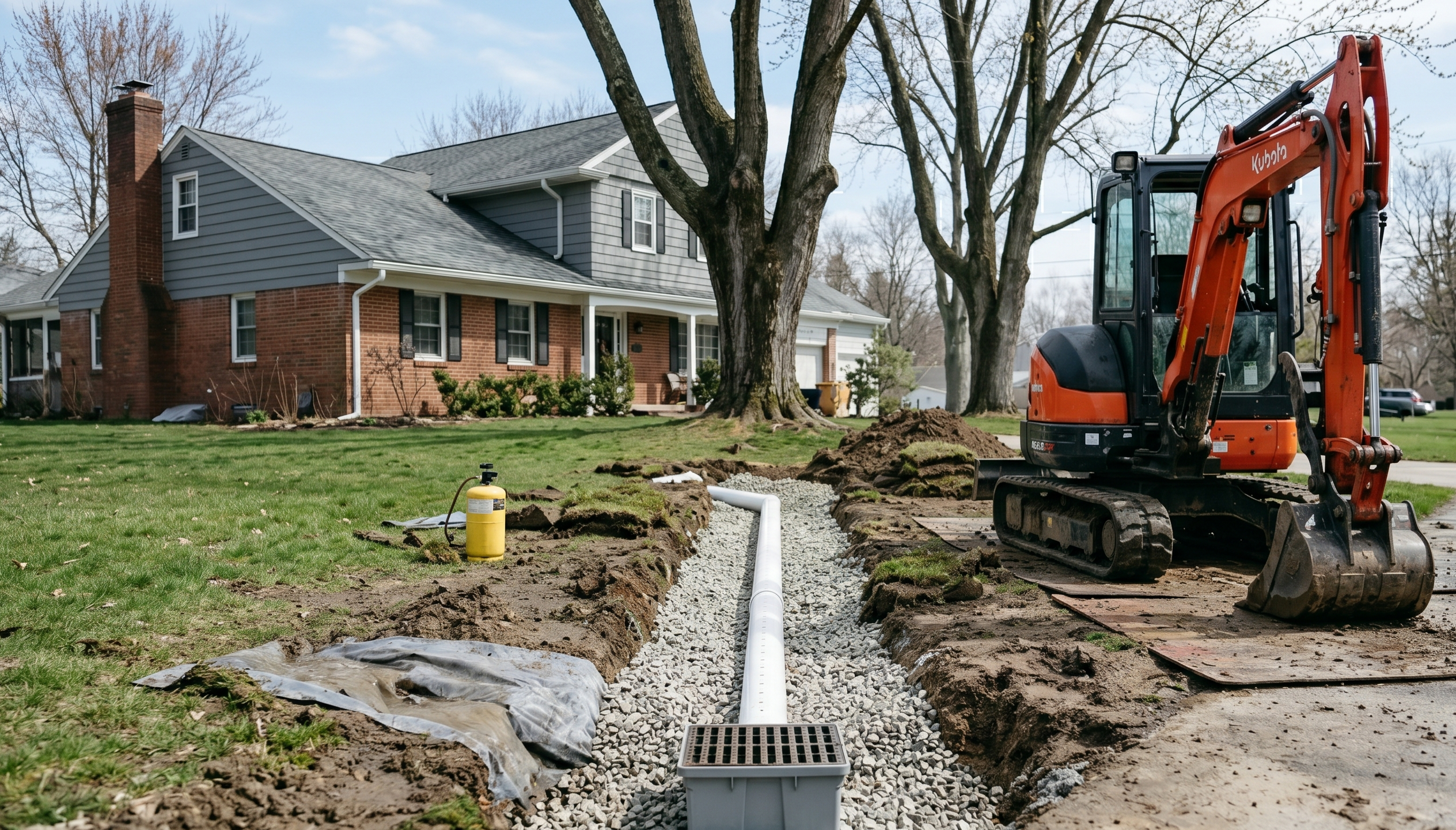
Our high-capacity French drains utilise heavy-gauge, rigid perforated PVC piping wrapped in commercial-grade geotextile fabric to prevent siltation. Instead of standard pea gravel, we utilise clean, washed #2 crushing stone to maximise the void space within the trench. This allows the system to capture massive volumes of subsurface water migrating through the topsoil and quickly redirect it to a safe discharge zone, such as an engineered drywell or an approved municipal storm connection.
2. Downspout Underground Redirection (Extension Burying)
Your roof is the largest water catchment area on your property. If your downspouts discharge within 5 feet of your foundation, they are actively contributing to basement flooding during a heavy thaw.
We excavate precise trenches to bury smooth-wall PVC conduit (which flows much faster and resists debris accumulation far better than corrugated piping) to carry roof runoff completely away from the home’s perimeter. During a rapid snowmelt event, keeping roof water separate from foundation water is your absolute first line of defence.
3. Catch Basins and In-Line Sump Discharge
When snow melts rapidly on driveways, patios, and low-lying lawn areas, surface pooling occurs instantly. Installing heavy-duty catch basins with integrated sediment traps and grated tops at strategic low points captures this surface water before it can saturate the surrounding soil. Furthermore, if your basement sump pump is cycling constantly, we can engineer an exterior discharge line that connects your sump output directly into an airtight, frost-protected bubbler pot system, preventing the pumped water from recycling back into your basement.
4. Strategic Swales and Rain Gardens
Not all drainage solutions need to be invisible. By sculpting the topography of your landscape, we can create elegant, functional dry creek beds and swales. These shallow, rock-lined channels act as natural highways for meltwater, steering it safely around your home. At the end of the channel, a native rain garden planted with water-loving, deep-rooted perennials can naturally absorb and filter the water into the lower aquifers once the deep frost thaws.
Frequently Asked Questions
What is the functional difference between a surface catch basin and a French drain?
Catch basins are engineered to capture large pools of open surface water immediately (like a puddle forming on your concrete patio or driveway) via an open overhead grate. French drains work entirely underground, collecting hidden groundwater that is saturating the subsurface soil layers and filtering it away seamlessly before it can rise to the surface.
Will an underground downspout extension freeze shut in a Western New York winter?
Not if designed and installed by professionals. We install underground redirection systems with a steep, consistent downward slope toward the discharge point, ensuring that water runs out immediately without pooling. We also use smooth-wall rigid PVC pipe rather than corrugated plastic, meaning there are no interior ridges to catch debris or trap ice pockets.
Localized Expertise: Navigating Erie County’s Soil and Topography
Drainage is not a one-size-fits-all trade. The soil composition in Western New York varies dramatically by town, and your specific coordinates dictate the exact engineering required to solve your water issues.
- The Northtowns (Amherst, Clarence, Tonawanda): These areas are notorious for heavy, dense clay soils and high water tables. Clay has incredibly poor infiltration rates. When snow melts here, it sits on the surface indefinitely. Drainage solutions in Amherst and Clarence require extensive subsurface piping and deep gravel envelopes to mechanically force water to move, as the soil will not absorb it naturally.
- The Southtowns (Orchard Park, Hamburg, East Aurora): While some areas enjoy gravelly loam, many Southtowns properties deal with severe elevation changes and rolling hills. Here, snowmelt manifests as rapid surface sheets flowing downhill from neighboring properties. Solutions in these regions focus heavily on interceptor drains (curtain drains) and professional landscape grading in Orchard Park to divert rushing water around the homestead
Furthermore, our team designs every system to comply strictly with local municipal codes. Towns like Cheektowaga and West Seneca have explicit guidelines regarding where stormwater can be discharged, and we ensure your system protects your property without negatively impacting your neighbors or violating local environmental statutes.
Frequently Asked Questions
Can I legally drain my property’s snowmelt runoff into the municipal street curb?
It depends entirely on your specific town, village, or city ordinances within Erie County. Some municipalities allow direct connection to municipal storm sewers, while others mandate that water must terminate within a bubbler system on your own property lines. 10x Landscaping designs every layout to stay completely compliant with your specific town code.
Why does my neighbor’s yard drain perfectly while mine stays swampy for weeks?
Micro-topography and varying soil layers play a huge role. Even on the exact same street, one yard might sit in a slight geographical dip or contain a higher concentration of dense, unyielding clay soil right beneath the topsoil layer, which prevents water from sinking down naturally.
The 10x Landscaping Framework: Assessment to Installation
At 10x Landscaping, we approach drainage through a lens of civil engineering and premium craftsmanship. We don’t guess where the water goes; we calculate it. Our comprehensive installation process includes:
- Topographical Laser Levelling: We map the micro-elevations of your property to determine exact high and low points, calculating precise slope percentages to guarantee positive, gravity-fed water flow.
- Soil Compaction Analysis: Understanding your yard’s clay-to-sand ratio allows us to size gravel envelopes and pipe diameters accurately.
- Subsurface Utility Mapping: Before a single shovel hits the dirt, we coordinate with Dig Safely New York 811 to map all underground gas, electric, and fibre-optic lines.
- Impact-Minimising Excavation: We use specialized turf-friendly machinery and protective matting to ensure your existing lawn experiences minimal disruption during the installation process.
Frequently Asked Questions
How deep do you have to dig to install a high-capacity residential French drain?
Typically, trenches are excavated to a depth of 18 to 24 inches, depending on the specific grading requirements of your yard. This depth ensures we are embedded securely below the primary turf root zone while establishing enough slope for gravity to guide the water seamlessly away.
Will my lawn and landscaping be completely destroyed during the excavation?
We understand how much pride you take in your landscape. Our crew uses plywood tracking paths and highly specialized low-impact, lightweight excavation machinery designed to disperse weight evenly. While digging is necessary, we meticulously replace your topsoil and reseed affected zones so your lawn recovers rapidly.
Buffalo Drainage Solutions Near Me: Our Service Areas
When you are looking for dependable yard drainage expertise near you, proximity and local knowledge matter. 10x Landscaping provides commercial and residential exterior drainage engineering across the entire Western New York region, including the following:
- Buffalo (City Proper): Serving neighborhoods from North Buffalo to South Buffalo with foundation protection systems.
- The Northtowns: Providing specialized clay-soil drainage systems across Amherst, Clarence, Williamsville, Tonawanda, and Kenmore.
- The Southtowns: Designing slope redirection, curtain drains, and swales in Orchard Park, Hamburg, East Aurora, West Seneca, and Lancaster.
- Cheektowaga & Depew: Resolving high-water table and sump pump discharge challenges near the I-90 corridor.
No matter where your property is situated in Erie County, our team is equipped to provide permanent relief from seasonal flooding.
Frequently Asked Questions
How fast can your team respond to an active flooding drainage emergency near me?
While we recommend installing drainage systems proactively during dry weather, we do offer assessments for homeowners experiencing active spring melt crises. Contact our office directly for real-time booking availability in your specific town.
Do you provide drainage solutions for commercial properties near Buffalo as well?
Yes! In addition to residential landscapes, we engineer and install heavy-duty commercial catch basins, parking lot runoff pathways, and large-scale retention swales for business owners throughout Western New York.
Protect Your Investment Before the Thaw Begins
Waiting until your basement is damp or your backyard resembles a small lake means dealing with costly foundation repairs, mold remediation, and ruined landscaping. Managing heavy snow melt requires proactive planning and professional-grade infrastructure designed specifically to survive and conquer Buffalo’s harsh winters.
If you notice standing water during seasonal thaws, soft spots in your lawn, or efflorescence on your basement walls, your property is telling you that its current drainage footprint is failing.
Contact 10x Landscaping today to schedule a comprehensive property drainage evaluation. Our local experts will assess your grade, analyse your soil, and construct a permanent solution tailored to keep your home dry and secure all year long. Let us handle the water so you can enjoy the spring.
Frequently Asked Questions
When is the absolute best time of year to install a drainage system in Buffalo?
Late spring, summer, and early autumn are the optimal installation windows. Trying to trench frozen winter ground is ineffective, and waiting until a massive spring thaw has already flooded your property limits what can be safely executed on short notice. Preparing during dry, warm weather ensures your property is fully armoured before the next snow accumulation.
Can exterior landscape drainage solutions replace the need for an interior basement waterproofing system?
In many instances, yes! Interior basement systems are designed to manage water after it has already penetrated your home. Our exterior drainage philosophy focuses on intercepting and redirecting that water while it is still outside, eliminating the root cause of hydrostatic foundation pressure entirely.