


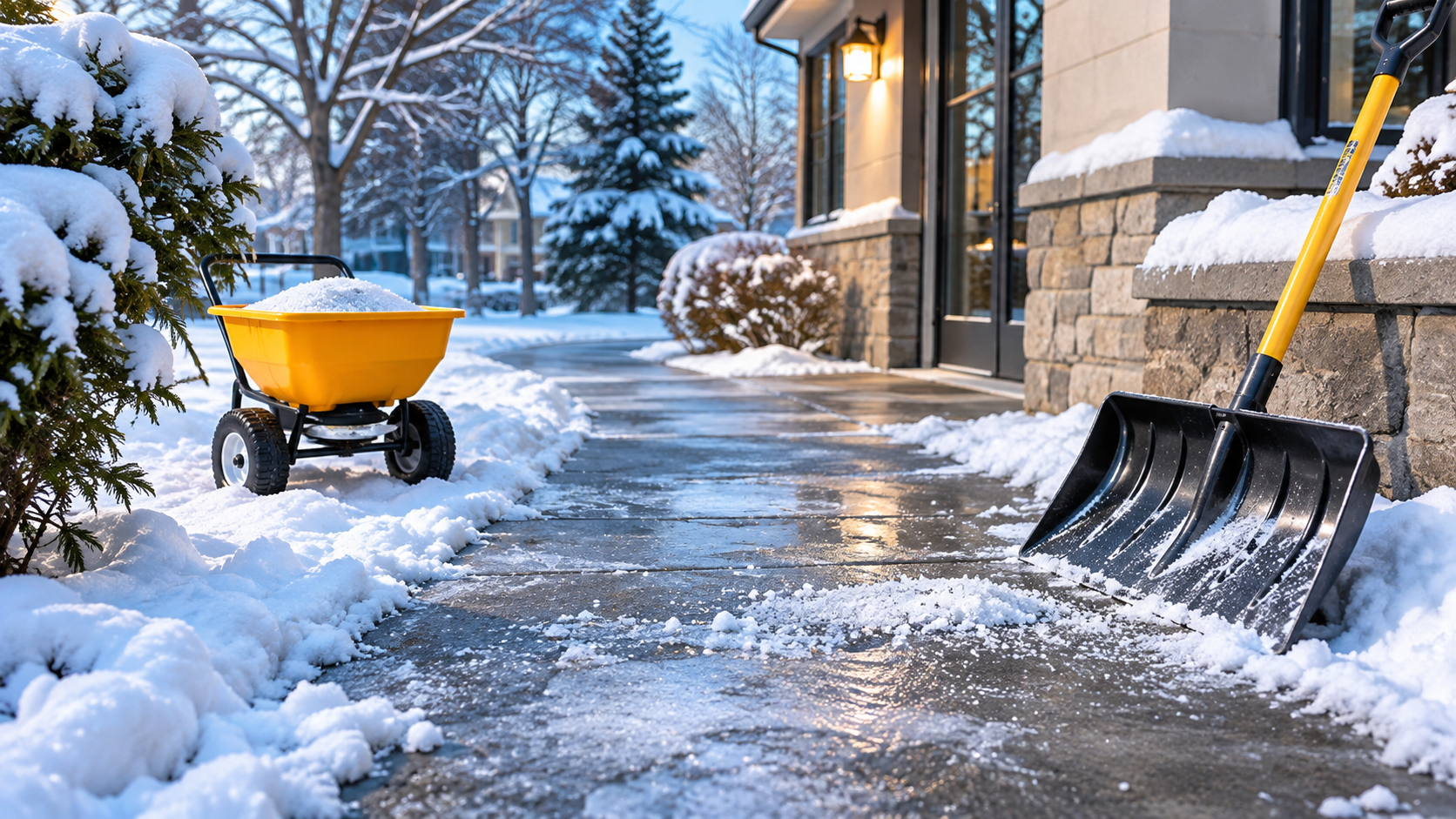
Every November the same thing happens around here. The first real lake-effect band rolls across Erie County, the forecast turns serious, and property owners start asking the question they’d rather not think about all year: if somebody slips on my ice, whose problem is it?
At 10x Landscaping & Snow Plowing Service, we plow and salt driveways, parking lots, private roads and multi-property sites across Orchard Park and Buffalo. After five-plus winters in this work, it’s a question we think every owner should settle before the first storm. The honest answer is “it depends,” but it depends on things you can control.
This guide covers what Western New York property owners are actually responsible for in winter, how the storm-in-progress rule works, why a plow contract isn’t a legal shield, and the simple records that protect you. We’re snow professionals, not lawyers, so read this as a practical field guide rather than legal advice. There’s a full disclaimer at the end.
Who Is Responsible When Someone Slips on Your Property?
Snow-and-ice injury claims in New York generally fall under premises liability. Courts have described the core test the same way for years: a property owner, or whoever is in possession of the property, is typically held liable only when they created the dangerous condition or had actual or constructive notice of it.
In plain English, that means one of three things: you (or your crew) caused the hazard, you knew about it, or it had been there long enough that you reasonably should have known. “Constructive notice” is the tricky one. A patch of ice that has sat at your front door since yesterday afternoon is very hard to defend with “I didn’t see it.”
Owner, tenant, manager: who counts?
The law looks at who controls the space. That can be the owner, a tenant in possession, a property manager, or several of them at once. Your lease might say the tenant handles the lot while the landlord handles the walkways. That language matters between the two of you, but an injured visitor never read your lease. So we tell every client the same thing: know exactly who is responsible for each area of the property, and put it in writing.
Your public sidewalk is probably your job, too
In the City of Buffalo, the code makes the owner or occupant of premises abutting a public street responsible for clearing the sidewalk of snow and ice before 9:00 a.m., and a separate provision requires any accumulation to be removed within 24 hours after the snow or ice stops falling. The same section says violators can be held liable for resulting injury or damage. The penalty amounts sit in a different chapter of the code; local reporting puts the fine at $100 per violation, and the city’s pedestrian advisory FAQ notes that owners of most commercial and nonresidential buildings are responsible for their frontage.
Out in Orchard Park, the Town Board’s 2022 snow and ice local law, as set out in its meeting record, makes it unlawful for an adjoining property owner to let three inches of snow or ice remain on a sidewalk. Every town and village in Erie County sets its own timelines and penalties, so check your municipality’s current code before you assume anything.
The city owns the sidewalk. Why is clearing it my job?
Owning a sidewalk and being responsible for clearing it are two different things. Buffalo’s code puts the clearing duty on the adjoining owner or occupant even though the walkway is public. Check your own town or village code.
Does a tenant’s lease move the responsibility off the landlord?
It can shift duties between landlord and tenant, but it doesn’t necessarily change what your municipality expects or how an injured person’s claim is handled. Have an attorney review the lease language if the split isn’t crystal clear.
Not sure what your winter plan actually covers?
Tell us about your property, whether it’s a driveway, a plaza lot or a multi-property site in Orchard Park or Buffalo, and we’ll talk through what needs clearing, when, and who’s responsible for what.
The “Storm in Progress” Rule: Your Window, Not Your Excuse
New York courts recognize that nobody can keep every surface clear while snow is still coming down. Under the storm-in-progress rule, a landowner’s duty to fix a storm-caused hazard is suspended while the storm is going on and doesn’t restart until a reasonable time after it ends.
There’s no stopwatch for “reasonable.” It depends on how bad the storm was, what kind of property it is, and how many people use it. The rule isn’t limited to powder, either. In Sherman v. Thruway Authority, the Court of Appeals applied it to an overnight ice storm and near-freezing rain, so freezing rain and wintry mix count as “storm” too.
Where owners lose the protection
- The clock runs out. Once the storm has really ended, you’re expected to act within a reasonable time. Leaving a lot untouched until noon the next day because “it had stopped snowing” is a hard position to defend.
- You clear carelessly mid-storm. Courts have noted that if an owner starts snow removal during a continuing storm, it has to be done with reasonable care, or the owner can be blamed for creating or worsening the hazard.
- Melt and refreeze. This is the one we see all the time around here. A plow pile melts in the afternoon sun, runs across the walkway, and turns to glass by 6 a.m. If your work created or worsened the icy spot, the storm-in-progress argument gets a lot weaker.
- You can’t prove the timeline. Defendants who rely on the rule usually need weather records showing when the storm actually ended. Lake-effect bands make this a real argument, because one side of town can be buried while another sees sunshine.
If it’s only snowing lightly, am I still covered?
Not automatically. Courts in our region have applied the rule even when precipitation had slowed, but the outcome depends on the facts of each case. Don’t build a winter plan around hoping the rule applies.
Should I wait for the storm to end before plowing?
For busy properties, usually not. That’s why many commercial plans use snowfall triggers and return visits. If you do clear during a storm, do it carefully, keep piles away from walkways, and write down what was done and when.
Does Hiring a Snow Contractor Move the Risk Off You?
Short answer: not entirely. In Espinal v. Melville Snow Contractors, the New York Court of Appeals held that a contract alone generally doesn’t create tort liability to a third party such as a visitor who slips. The court did carve out exceptions, and later cases spell out three of them:
-
The contractor, by failing to use reasonable care, makes the situation worse.
A careless plow job that creates or worsens an icy patch is the classic example.
-
The injured person relied on the contractor continuing to do the work.
-
The contract is so comprehensive that it entirely replaces the owner’s duty to keep the premises safe.
What does that mean for you? A plow operator who leaves a pile that drains across your walkway may carry exposure for that. But an injured visitor’s lawyer will usually look at the property owner too, because you control the site. Who ultimately pays between you and your contractor is a separate question, answered by your contract, insurance and any indemnity language.
| Who | Typically responsible for | Where risk can show up |
|---|---|---|
| Property owner / manager | Keeping the premises reasonably safe; knowing who handles each area; choosing and overseeing vendors | Known hazards left alone, no inspections, no records, ignored complaints |
| Tenant in possession | Areas the lease assigns to them, such as entrances and private lots | Lease gaps, shared entrances and walkways nobody “owns” |
| Snow contractor | Doing the contracted scope with reasonable care | Work that creates or worsens a hazard; scope gaps nobody is covering |
Here’s our take: a good contractor is a partner in the plan, not a liability shield. That’s how we approach every site at 10x Landscaping & Snow Plowing Service. Trigger depth, areas, salting and return visits get written down, so nobody is saying “I thought you were handling the back entrance” at 5 a.m. on an icy morning. If you’re weighing options, our guide to seasonal contracts vs. per-visit plowing breaks down how each structure changes who’s on the hook for what.
If my contractor carries insurance, am I safe?
It helps, but it isn’t a guarantee. Ask for the certificate of insurance, ask whether you can be listed as an additional insured, and have your own insurer confirm how the coverage fits together.
What if my agreement is “plow only” and doesn’t mention salt?
Then ice management may be nobody’s job. Plowing removes snow; it doesn’t treat ice. Make sure the written scope says who salts or de-ices, when, and where.
Your Best Defense Is a Boring, Consistent Snow and Ice Log
Most winter slip-and-fall disputes come down to what you can show: what the weather did, what you did, and when. Memory is a weak witness. A dated log is a strong one. It doesn’t need to be fancy. A shared spreadsheet or a notes app works, as long as you use it every storm.
| What to record | Details to include | Why it matters |
|---|---|---|
| Storm timeline | Start and end times, type (snow, freezing rain, mix), rough totals. Cross-check against National Weather Service Buffalo data | Supports the storm-in-progress timeline |
| Crew visits | Arrival and departure times, who was on site, areas cleared | Shows a reasonable response |
| Ice management | Product used, where it was applied, time | Shows you treated ice, not just snow |
| Photos | Wide and close-up, timestamped, before and after; entrances, steps, accessible parking | Visual record of conditions |
| Inspections | Walk-throughs, especially after a thaw or an overnight temperature drop | Shows you looked for hazards (notice) |
| Complaints and incidents | Who reported what, when, and what you did about it | Notice is central to most claims |
| Delays and gaps | Equipment trouble, road closures, travel advisories | Honest context for any delay |
Habits that make a log believable
- Write entries at the time, not three weeks later. Consistency beats detail.
- Have the same person (or a clear process) fill it out every storm.
- Back it up digitally. Paper gets wet, and phones get lost.
- Never edit or delete an old entry. If something needs correcting, add a new dated note.
If someone does fall
- Check on the person first, and call 911 if they’re hurt.
- Photograph the area before conditions change, and note the weather and time.
- Get names and contact details for witnesses.
- Stick to facts. Don’t speculate about cause or fault at the scene.
- Notify your insurance carrier promptly, and save your logs, invoices and any camera footage.
- Talk to an attorney before giving any formal statement.
How long should I keep my snow logs?
Longer than you’d think. In many New York personal injury cases, injured people have up to three years to file, so a lot of owners keep winter records at least that long. Your insurer or attorney can give you a firm answer for your situation.
Do phone photos really count?
Timestamped photos taken the same way every storm are generally far easier to rely on than anyone’s memory. The goal is a consistent, honest record, not perfect pictures.
Icy Parking Lots: The Spots That Deserve a Second Look
If you’re wondering who is liable for an icy parking lot, the usual starting point is whoever owns or controls it, with a contractor potentially sharing exposure if their work created the problem. The more useful question is how to keep the lot from becoming a problem in the first place. Here’s where we look first on commercial and multi-property sites:
- Entrances and exits. Everyone funnels through the same few feet, and tracked-in slush refreezes just outside the door.
- Accessible parking and ramps. These need to be clear and treated, not just plowed.
- Downspout and roof-drainage discharge zones. Water keeps coming even when the sky is clear.
- Plow-pile melt paths. Follow the slope. Wherever meltwater runs, ice follows.
- Low spots and drain edges. Water pools, then freezes in a sheet.
- Dumpster pads and loading areas. Staff walk these early, often in the dark.
- Steps and handrails. Often missed because they sit outside the plow route.
Timing matters as much as technique. Buffalo winters can swing from thaw to deep freeze inside a day, and that melt-then-refreeze cycle is what turns a clear lot into a skating rink by early morning. Where you stack snow matters too. Pick storage areas away from walkways, drains and driveway sight lines, and write them into your plan before the first storm.
That’s exactly the type of detail we cover when we build a plan for a commercial lot or multi-property site. You can see how we handle parking lot and driveway plowing and our wider snow removal services in Orchard Park and Buffalo on our service pages.
How to Choose a Snow Contractor With Liability in Mind
Price matters, but it shouldn’t be the only filter. When you’re comparing contractors, whether that’s us or anyone else, these are the questions that tell you whether the plan will hold up when something goes wrong:
- Can I see your certificate of insurance? And can I be listed as an additional insured?
- What triggers a visit? Snow depth, ice, or both, and is it written down?
- Who treats ice? Plowing and salting are different jobs. Confirm both are in scope.
- What do I get after each visit? Timestamps, photos or a service report make your log far stronger.
- Who checks for refreeze, and when? The early-morning inspection is where many plans have a gap.
- How do I reach someone at 4 a.m.? A storm doesn’t wait for office hours.
We’ve put the full checklist in our guide to the questions to ask a snow removal contractor, and if you’re still deciding on timing, our post on when to book snow removal explains why November is not too early. For budgeting, see our snow removal cost guide.
Ready for a plan you can actually document?
10x Landscaping & Snow Plowing Service handles driveways, commercial lots, private roads and multi-property sites in Orchard Park, Buffalo and surrounding Erie County. Tell us what you manage and we’ll help you map out the winter.
- Driveway & commercial lot plowing
- Private roads & multi-property sites
- Salting & de-icing
or email sales@10xlandscaping.com
More Quick Answers
Is salting legally required?
There’s no single rule we can point to that fits every property. What matters is whether you acted reasonably under the conditions, and for most sites that includes treating ice, not just moving snow. Your attorney or insurer can speak to your specific situation.
Which areas does 10x Landscaping & Snow Plowing Service cover?
We serve Orchard Park and Buffalo, plus surrounding Erie County and Western New York communities. Call (716) 303-3595 and we’ll confirm your address.