


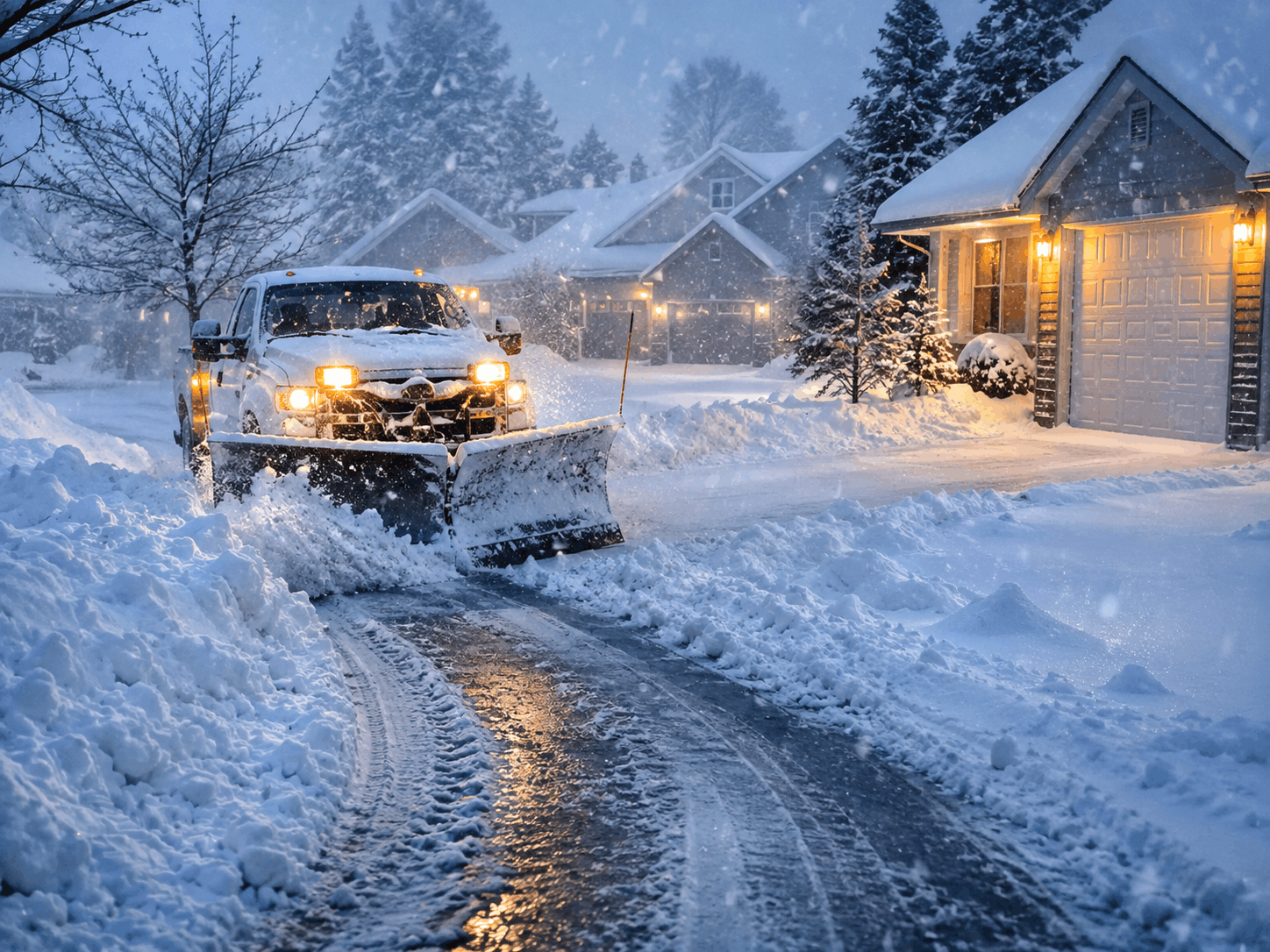
What to Know Before You Book Snow Plowing
A few simple details can make a big difference during a Buffalo winter storm.
For most Buffalo-area driveways, the sweet spot is a plow pass every 2–6 inches of accumulation — not one big cleanup after the storm ends.
Most residential snow plowing contracts in Western New York use a 2-inch or 3-inch trigger depth: once snowfall crosses that line, your driveway goes into the route.
During a long lake-effect event, expect multiple visits — often one pass every 4–8 hours while the snow keeps falling, plus a final cleanup pass at the end.
Waiting until a 12-inch storm is “over” almost always costs more: snow compacts, bonds to the pavement as ice, and takes longer (and heavier equipment) to remove.
Plow trucks run routes, not appointments — knowing your trigger depth and route window tells you when the plow truck will actually come.
If you’ve lived through even one real Buffalo winter, you already know the question isn’t whether your driveway will need plowing — it’s how many times before the storm finally lets up. Lake-effect snow off Lake Erie doesn’t politely drop four inches and move on. It parks a band over South Buffalo, Orchard Park, or Hamburg and hammers one neighborhood for twelve hours while the sun shines twenty minutes north.
At 10x Landscaping & Snow Plowing Service, we’ve spent years running plow routes across Buffalo, Orchard Park, and the surrounding Erie County towns, and this is easily one of the questions we get asked most: “How often should my driveway actually be plowed during a storm? Can’t you just come once at the end?” It’s a fair question — every plow pass feels like it should cost something, so fewer passes sounds cheaper. In practice, it usually works the other way around. Let’s walk through how snow plowing frequency really works, what a trigger depth is, and how to know when the plow trucks come during an ongoing storm.
The Short Answer: Plow Every 2–6 Inches, Not Once at the End
Here’s the rule of thumb we give every homeowner who signs up with us: a residential driveway should be cleared each time 2 to 6 inches of new snow accumulates, depending on your contract, your driveway, and who lives in the house. During a typical WNY storm that drops 8–12 inches overnight, that usually means two to three passes — not one.
Why not just wait? Because snow isn’t a static pile — it changes the longer it sits. Fresh powder at 3 inches pushes off asphalt in seconds. That same snow after cars have driven over it, after a freeze-thaw cycle, after the town plow has shoved a slushy windrow across the end of your driveway? Now it’s dense, bonded, and halfway to ice. The job goes from a two-minute pass to a scraping battle, and no plow blade fully wins a battle against pack ice.
There’s also a limit in the other direction. Plowing every dusting of half an inch wastes money and puts unnecessary blade wear on your asphalt sealcoat. That’s exactly why the industry uses trigger depths — so let’s talk about those.
What Is a Snow Trigger Depth (And Why It Decides Everything)
A trigger depth (sometimes called a “service trigger” or just “the trigger”) is the amount of accumulated snow that automatically activates your plow service. No phone call needed, no request submitted — once the snow crosses the trigger, your driveway is on the route. It’s the single most important number in any snow plowing agreement, and it’s the honest answer to “how many inches before plowing?”
Common residential trigger depths in Buffalo & WNY
• 2-inch trigger — the most common residential standard around Buffalo. Your driveway stays consistently usable, ice rarely gets a chance to bond, and daily-driver households barely notice storms. This is what we recommend for most families and for anyone with a sloped driveway.
• 3-inch trigger — a slightly more economical setup, common on per-push billing. Still very manageable for most vehicles; you’ll just occasionally drive over a couple inches on your way out in the morning.
• 4-inch+ trigger — we generally only suggest this for seldom-used properties, seasonal homes, or long rural lanes where cost control matters more than constant access. With Buffalo’s snowfall, a 4-inch trigger means you will regularly be driving through real snow.
• 1-inch or “zero-tolerance” — standard for commercial lots, medical needs, and anyone who can’t risk a slip hazard. More passes, more cost, cleanest possible pavement.
One local wrinkle worth knowing: trigger depth is measured on new accumulation since the last pass, not total storm snowfall. In a 14-inch lake-effect event with a 2-inch trigger, your driveway doesn’t get one visit “because the trigger was met” — it re-triggers every time another 2 inches stacks up. That’s the mechanism that turns one storm into three or four visits, and it’s exactly what keeps the driveway drivable.
Quick FAQ: What’s the best trigger depth for a normal Buffalo driveway?
For most households, 2 inches is a practical trigger. It keeps the pavement consistently clear, helps prevent ice from bonding, and matches how many seasonal contracts in Erie County are structured. If you’re on per-push billing and want to reduce the number of visits, 3 inches may be worth discussing.
Quick FAQ: Does the trigger reset after each plow pass?
Yes. Trigger depth measures new snow since the last clearing, not the total amount that falls during the storm. For example, a 10-inch storm with a 2-inch trigger could require 3–5 visits, depending on the snowfall rate and storm conditions.
Quick FAQ: Can I have different triggers for different storms?
Some contracts allow different trigger settings, but most use one trigger depth for the entire season so routes stay predictable. If your needs change depending on the storm, ask your snow-plowing provider about a hybrid setup before the season begins.
How Many Inches Before Plowing Actually Makes Sense?
If you’re plowing your own driveway or deciding what trigger to sign up for, here’s how we’d break it down after years of watching what different depths do to different driveways across Western New York:
• Under 2 inches: usually shovel-or-ignore territory — unless temperatures are hovering near freezing. Wet 1-inch slush that refreezes overnight is more dangerous than 4 inches of dry powder. Salt matters more than the blade at this depth.
• 2–4 inches: the ideal plowing window. Snow moves easily, doesn’t overload the blade or the machine, and clears down to pavement in one pass. This is where plowing is cheapest per inch removed.
• 4–8 inches: still very plowable, but heavier and slower, especially the wet “heart-attack snow” we get off the lake in early winter. Expect the pass to take longer and the windrows at the edges to get tall.
• 8–12+ inches in one sitting: this is where waiting has real costs. Trucks have to push in stages, deep snow strains equipment, piles eat into your parking space, and anything compacted underneath tends to stay behind as hardpack.
The pattern is simple: frequent, shallow passes beat rare, deep ones — for your pavement, for your car’s suspension, for your back, and usually for your wallet. It’s the same reason state plow crews keep the Thruway staffed 24/7 all winter, circulating through every storm instead of waiting for the sky to clear.
Plowing During an Ongoing Storm: One Pass or Several?
This is where Buffalo differs from most of the country. In a lot of places, “a snowstorm” is a six-hour event. Here, a single lake-effect setup can snow on the Southtowns for a day and a half straight. The November 2022 storm buried Orchard Park under roughly 77 inches — nobody was waiting for that one to finish before plowing. So how should service actually work while the snow is still falling?
Light snowfalls (under 4 inches total)
One pass near the end of the snowfall is usually fine, ideally timed before the morning or evening commute. If temps are dropping fast behind the storm, a salt or de-icing application with that pass is worth far more than a second plow visit — refreeze is the real enemy on light events.
Moderate storms (4–8 inches)
Two passes is the standard play: one mid-storm pass once the trigger is hit, and a cleanup pass after the snow tapers — including the dreaded windrow the municipal plow leaves across your driveway apron. That second pass is also when edges get squared off and the sidewalk and mailbox approach get attention.
Lake-effect events and multi-day storms (8+ inches)
During an ongoing heavy storm, professional crews stay in continuous rotation — in practice, that means your driveway sees a pass roughly every 4 to 8 hours while snow keeps accumulating, then a final detail pass at the end. Continuous rotation is what keeps a driveway recoverable. Once snow depth passes what a pickup blade can push in a single bite (roughly 8–10 inches of dense snow), everything slows down and costs climb. It’s also a safety issue: if an ambulance or fire crew needed to reach your house mid-storm, a driveway maintained every few hours is accessible — one buried under 20 unplowed inches is not.
Our crews at 10x Landscaping & Snow Plowing Service plan routes around exactly this rhythm during major events: rolling passes through the storm, then a full cleanup — driveway, apron, windrow, walkway — once the band finally slides off your neighborhood.
Quick FAQ: Should I ask my plow guy to wait until the storm is completely over?
For anything over about 6 inches, no. Waiting lets snow compact and bond to the pavement, which can make the final clearing slower and more difficult. It also leaves your driveway blocked in the meantime, including when emergency access matters.
Quick FAQ: Will the plow come back if the town plow blocks my driveway again?
On a full-service route, typically yes. A post-storm cleanup pass can clear the apron windrow left by the municipal plow. If you’re on strict per-push billing, confirm whether windrow returns count as an extra visit before the season starts.
Quick FAQ: What about drifting after the snow stops?
Wind events can create a separate service need. If drifting rebuilds 2–3 inches across the driveway after the storm, many contracts may treat it as a new service event. Open, exposed properties in the Southtowns can be especially susceptible to drifting.
When Do Plow Trucks Come? Understanding Route Timing
Residential plowing runs on routes, not appointments. Every truck has a loop of driveways ordered for efficiency, and the whole loop cycles each time the trigger is met area-wide. Two things determine when the truck reaches you:
• Where you sit on the route. Position is usually geographic, with priority slots for medical needs, steep driveways, and early commuters. Good companies will tell you your approximate service window instead of leaving you guessing at 5 a.m.
• Snowfall timing. Most crews aim to have routes cleared before the morning commute (roughly 4–8 a.m.) and again before the evening return. If snow is falling at 2 inches per hour — which lake-effect bands absolutely do — the route restarts as soon as it finishes, and mid-loop driveways may briefly show fresh accumulation. That’s the route working, not the route failing.
Pro tip from our dispatch side: on storm days, check the National Weather Service Buffalo forecast for the band positioning before you call to ask where the truck is. If the NWS shows the band parked over your zip code, your route is cycling continuously — the truck is coming, it’s just fighting the same snow you’re looking at out the window. One local caveat: under an Erie County travel advisory, professional crews generally keep working — but a full driving ban can take everyone off the roads except emergency services until it’s lifted. When that happens, routes resume the moment the ban does, which is one more reason a trigger-based service beats trying to dig yourself out mid-whiteout.
Quick FAQ: What time do residential plow trucks usually come in Buffalo?
The first cycle typically runs between roughly 3 a.m. and 8 a.m. after an overnight trigger, so driveways are open for the morning commute. During daytime storms, routes can cycle continuously as the trigger re-fires.
Quick FAQ: Can I get an exact time?
No honest plow company can promise an exact time during an active storm. Snowfall rate, stuck-vehicle delays, and route order can all shift the service window. What you should get instead is a clearly defined trigger depth and approximate service window.
Why Waiting Until the Storm Ends Costs You More
It seems logical: one visit should cost less than three. Here’s what that math misses, from crews who’ve cleaned up plenty of “we decided to wait” driveways in January:
• Compaction and ice bonding. Every tire pass and every hour of sitting presses snow into the pavement. Once it bonds, a plow blade rides over it, and you’re into scraping, heavy salting, or living with hardpack until the next thaw.
• Deep-snow surcharges. Most per-push pricing has depth tiers. Clearing 12 inches in one shot is routinely billed at 1.5–2x a standard pass because it takes longer and works the equipment harder — often costing as much as the two mid-storm passes would have.
• Nowhere to put it. Snow storage is real estate. Frequent passes build piles gradually and keep them at the edges; one giant push creates walls that swallow parking space and bury the mailbox — and those walls are what turn into solid ice ridges by February.
• Safety and access. Shoveling deep, wet snow is a documented cardiac risk — the American Heart Association warns about it every winter. A maintained driveway means you’re never forced to hand-dig your way out mid-storm.
Per-Push vs. Seasonal Contracts: How Frequency Changes Your Bill
Plowing frequency and pricing structure are two sides of the same coin. On per-push billing, every trigger event is a line item, so a heavy lake-effect month can genuinely add up — and it’s why per-push customers are sometimes tempted to stretch their trigger to 3 or 4 inches. On a seasonal contract, you pay one flat rate and the truck comes as many times as the winter demands, which is exactly why seasonal agreements dominate in snow country: the risk of a brutal winter shifts to the contractor, and nobody is rationing plow passes in the middle of a storm.
We’ve broken down that whole decision — including what Buffalo’s snowfall history says about which option wins most winters — in our guide to seasonal snow contracts vs. per-visit pricing. And if you’re budgeting for the season from scratch, start with our full snow removal cost guide for Buffalo homeowners — it covers typical trigger depths, per-push ranges, and what’s usually included in each service level.
Buffalo-Specific Factors That Change the Answer
National advice about plowing frequency tends to assume “normal” snow. Western New York is not normal snow. A few local realities we plan routes around:
• Lake-effect bands are hyper-local. Orchard Park can take 3 feet while North Buffalo gets flurries. Your plowing frequency isn’t set by the regional forecast — it’s set by where the band sits, which is why trigger-based service beats scheduled service here.
• The freeze-thaw whiplash. Lake Erie keeps early-winter storms wet and heavy, then arctic air locks everything solid. Snow left on the driveway during the wet phase becomes the ice sheet of the cold phase. Frequency isn’t just about depth — it’s about clearing before the temperature drops.
• Municipal windrows. Town and city plows must push snow to the curb line, and physics puts it across your apron. In heavy storms they may pass multiple times, which means your driveway entrance can re-close even when no new snow has fallen. A good residential route accounts for windrow returns.
• Driveway slope and orientation. A north-facing sloped driveway in Hamburg holds ice weeks longer than a flat, sun-facing one in Cheektowaga. Slopes need tighter triggers and more consistent de-icing — traction failure on a slope isn’t an inconvenience, it’s a car in the yard.
How 10x Landscaping & Snow Plowing Service Handles Storm-Day Frequency
With 5+ years plowing Buffalo-area winters, we’ve settled on a system that takes the guesswork out of “how often”:
• Standard 2-inch trigger on residential routes, with custom triggers available for per-push customers and special-access needs.
• Continuous storm rotation during major events — rolling passes roughly every 4–8 hours while snow accumulates, so no driveway on our routes ever goes into deep-snow territory.
• Post-storm cleanup pass that squares up edges, clears the municipal windrow from your apron, and applies salt or de-icer where refreeze is a risk.
• Route transparency — you’ll know your approximate service window, and during named lake-effect events we communicate delays instead of leaving you staring down the street.
We serve Buffalo, Orchard Park, and the surrounding Erie County and Western New York communities with driveway, commercial, parking lot, private road, and multi-property plowing, plus salting and de-icing. If it snows on it, we plow it.
Get on the route before the season fills up.
Seasonal spots in Buffalo & Orchard Park are first-come, first-served — and they can fill quickly once the first lake-effect bands arrive.
The Bottom Line
So — how often should a driveway be plowed during a snowstorm? Every 2–6 inches of new accumulation, with rolling passes during long lake-effect events and a cleanup pass at the end. Set a sensible trigger depth (2 inches for most Buffalo homes), understand that routes cycle rather than run on the clock, and resist the urge to “save money” by waiting out the storm — compacted snow and bonded ice will collect that savings back with interest.
Winter here rewards the prepared. Pick your trigger, get on a route, and let the storm be the truck’s problem instead of yours.